Smart Dining Set for Small Spaces Solutions 2026


A small dining area often has to do three jobs at once. It holds weeknight meals, doubles as a homework spot, and sometimes becomes the only place to spread out mail, a laptop, or a board game. In many Bellefontaine and Logan County homes, that corner also sits right next to the kitchen or living room, so every inch has to work hard.
That pressure isn't just local. Search interest for “dining sets for small spaces” rose 9.38% in early 2025, and the global dining furniture market is projected to grow from USD 23.4 billion in 2023 to USD 41.2 billion by 2032 according to this dining furniture market overview. More households are trying to make smaller footprints feel warm, useful, and comfortable.
For families who feel stuck between “too cramped” and “not enough seating,” that can be reassuring. The problem usually isn't that a home is missing a dining room. It's that the room needs a smarter plan. A small-space setup can still feel welcoming, especially when the layout supports real life instead of fighting it.
That idea has guided local furniture help for generations. Since 1946, and with design support shaped by a history that reaches back to 1964, the goal has stayed simple. Help people love the homes they already have. Readers who are also trying to make another room breathe a little easier may find useful ideas in this guide to making a small room feel big.
Table of Contents
- Making Room for Memories in Your Cozy Home
- Measure Twice Buy Once Your Space Planning Guide
- Choosing the Right Shape for Your Dining Area
- Maximize Flexibility with Smart Table Designs
- The Perfect Pairing Seating for Small Dining Sets
- Create Your Look with Custom Finishes and Materials
- Your Partner from Showroom Floor to Your Dining Room
Making Room for Memories in Your Cozy Home
A compact dining area can still be the heart of a home. In practice, the most successful small dining spots aren't packed with furniture. They're arranged so people can move easily, sit comfortably, and stay awhile. That matters whether the room holds Sunday dinner for two, after-school snacks, or coffee with a neighbor.
In smaller homes, the dining set often sits in a shared zone. One side may open into the kitchen, the other into the living room, and a hallway may cut through both. That's why a dining set for small spaces isn't just about buying a smaller table. It's about choosing pieces that respect the room's traffic, sightlines, and daily habits.
Small homes don't need less personality. They need furniture that behaves well.
A good setup supports the little moments people remember later. Chairs pull out without bumping a sofa. The table doesn't crowd the walkway. The room still feels open enough to breathe. Those details sound small, but they shape how often a space gets used.
For many households, that realization brings relief. A cozy home doesn't need a formal dining room to feel complete. It needs a practical arrangement, a comfortable scale, and materials that fit the home's rhythm.
Measure Twice Buy Once Your Space Planning Guide
Start with the room, not the table
The most common small-space mistake is easy to understand. Someone sees a table that looks compact in a showroom or online, brings it home, and then realizes the room feels tighter than before. The tabletop fit. The movement around it didn't.
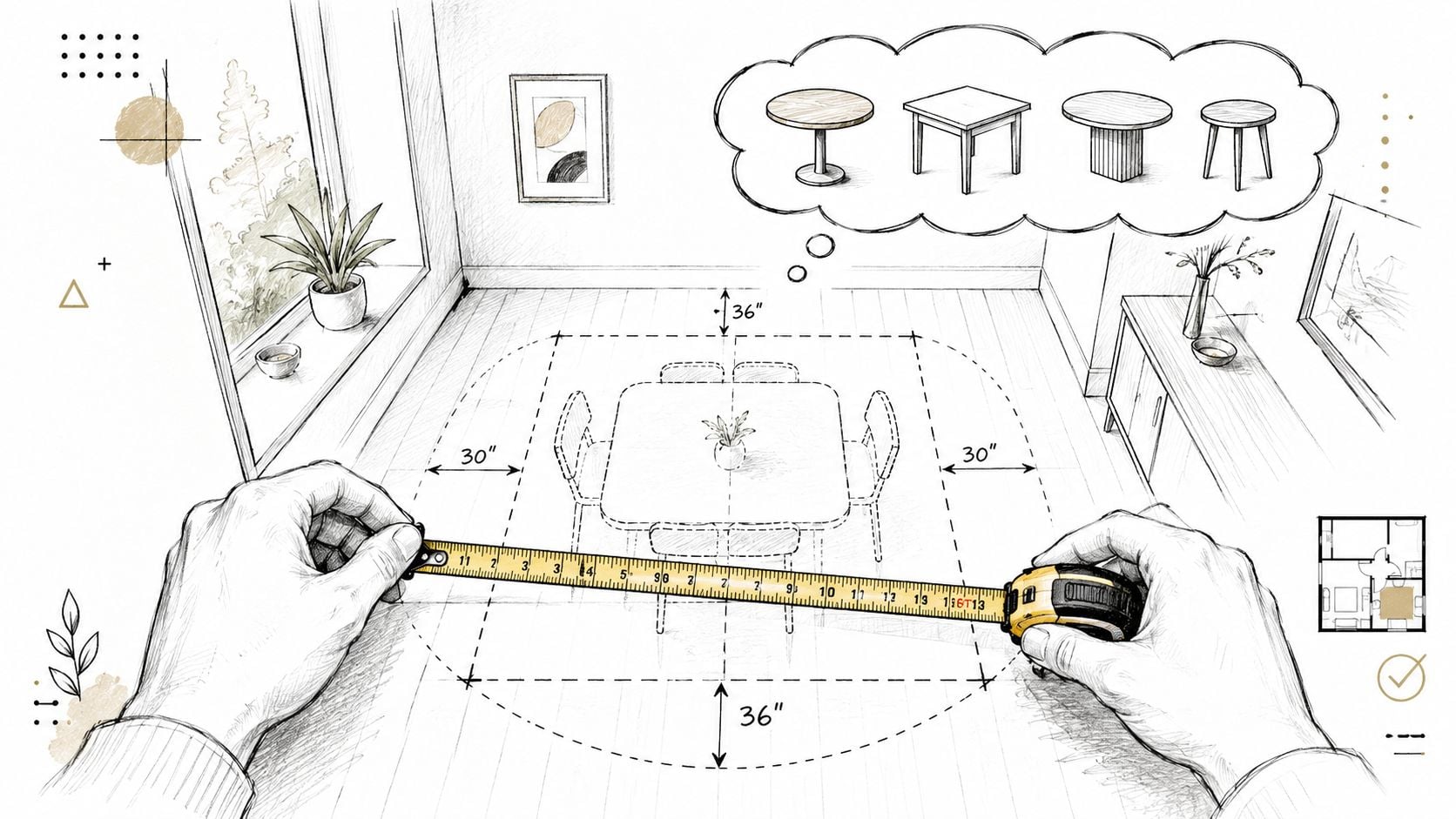
A long-standing rule for furniture arrangement is to leave 30 to 36 inches between the table edge and nearby walls or furniture, with 42 inches preferred along main walkways, according to this small dining layout guide. The same guide notes that compact round tables of 30 to 36 inches and small rectangular tables near 36 x 48 inches are often a good fit for 2 to 4 people. That rule matters because chairs need room to slide back, and people need space to pass without turning sideways.
A room should be measured as a working space, not an empty box. Door swings, nearby cabinets, radiator covers, and the path to the kitchen all count. A dining area that looks roomy on paper can feel crowded once those real-life obstacles are considered.
Readers who want a refresher on measuring basics may find this guide to accurate tape measure usage helpful before sketching out a floor plan.
Practical rule: Measure for the people moving around the table, not just for the table itself.
A simple measuring checklist
A clear process keeps small-space buying from becoming guesswork.
- Measure the open floor area first. Note the length and width of the space that can hold furniture.
- Mark the walkways. Identify the path to doors, kitchens, and adjoining rooms. Those lanes need to stay comfortable.
- Account for chair pull-back. A dining chair only works if someone can sit down and stand up without scraping a wall.
- Check nearby furniture. Sideboards, islands, sofas, and windowsills all affect usable space.
- Use painter's tape on the floor. A taped outline often reveals problems that room dimensions alone don't show.
Another smart move is to keep a simple sketch with notes. Even a rough hand drawing helps households compare options without relying on memory. For anyone thinking beyond one room, this overview of space planning basics can help connect layout decisions across the home.
Choosing the Right Shape for Your Dining Area
How shape changes the way a room feels
Once the room has been measured, shape becomes the next big decision. Many shoppers find this decision challenging. Two tables can take up a similar footprint but behave very differently in the same room.
A round table often works well in tighter layouts because there are no corners to dodge. That softer outline helps traffic move more naturally, especially when the dining area sits in a pass-through zone. It also tends to make conversation easier because everyone faces one another more directly.
A square table usually makes sense in a square nook or corner-based dining spot. It can feel balanced and tidy, especially in apartments or eat-in kitchens where the dining area has clear boundaries. The caution is that some square tables can feel tight once every seat is in use.
A rectangular table is often the answer for long, narrow rooms. It follows the shape of the space and can leave cleaner passage on either side if chosen carefully. In a combo living-dining room, that straight profile may pair more easily with nearby furniture.
Dining Table Shape Comparison for Small Spaces
| Shape | Best For | Pros | Cons |
|---|---|---|---|
| Round | Shared spaces, walkways, softer layouts | Easier flow, no sharp corners, friendly for conversation | Can be harder to place against a wall |
| Square | Breakfast nooks, corners, balanced rooms | Neat footprint, symmetrical look, simple seating plan | Can feel boxed-in if the area is narrow |
| Rectangular | Long rooms, open-plan edges, wall-adjacent layouts | Uses linear space well, familiar format, easy to pair with benches | Corners can interrupt traffic in tight spots |
A base style matters too. Pedestal bases usually free up legroom because there aren't table legs at each corner competing with chair placement. In a compact room, that difference can make seating feel less fussy.
The right shape should match the room's geometry first and personal taste second.
For shoppers comparing actual dimensions, this dining table size guide can help translate measurements into a more confident choice. That step is especially useful for anyone deciding between a compact rectangle and a round pedestal table.
Maximize Flexibility with Smart Table Designs
Tables that change with the day
Some homes don't need the same table all day long. A household may want a slim footprint on weekday mornings and more surface space on weekends. That's where flexible table designs earn their keep.
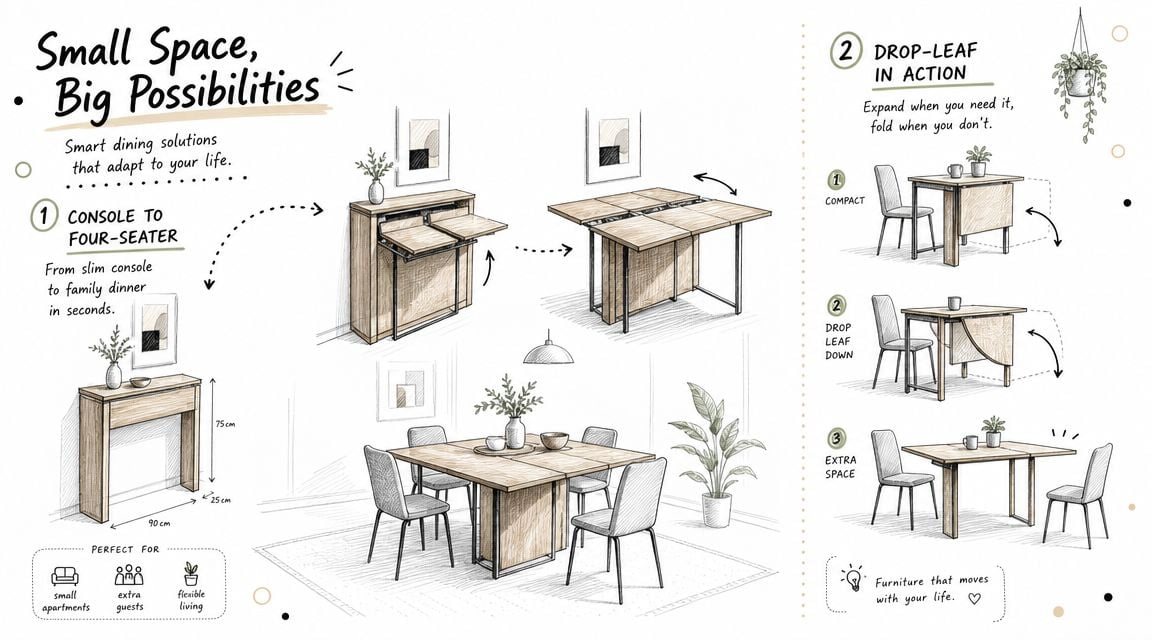
A drop-leaf table has hinged sides that lift up when extra room is needed and fold down when they aren't. It behaves a bit like a jacket with pockets. Compact most of the time, useful when the day asks for more.
An extendable table adds surface area when guests come over or when projects spread out. Some designs hide their extra section inside the table, which keeps the room from needing permanent space for a larger top. For a small home, that means the room can stay open until extra seating is needed.
A console-to-dining design can be helpful in multifunction rooms. In its closed form, it sits neatly against a wall. Opened up, it becomes a place to eat, work, or gather.
Who these designs help most
Flexible tables aren't only for tiny apartments. They also serve families who use one room for several activities.
- For renters: A changing layout often calls for furniture that can adapt to the next address.
- For open-plan homes: A table with foldable or extendable parts keeps the room from feeling overcommitted.
- For occasional hosts: Extra surface area can appear when company arrives instead of taking up floor space every day.
- For busy households: A smaller setup can free the room for homework, puzzles, or meal prep between meals.
A high-top or counter-height table can also work in the right room. It creates a more vertical presence and sometimes pairs well with stools that tuck neatly underneath. That said, comfort matters. If the household lingers over meals, standard dining height may still feel more relaxed.
One practical example is a compact drop-leaf option like this small-space drop-leaf dinette set. Pieces like that show how a dining set for small spaces can shift with daily life instead of locking the room into one use.
The Perfect Pairing Seating for Small Dining Sets
Why chairs can make or break the layout
A table gets most of the attention, but the seating often decides whether a small dining area feels light or crowded. Bulky chair backs, wide arms, and heavy frames can make a compact table seem larger than it really is.
A bench is one of the most useful small-space tools. It slides under the table when it's not in use, which clears visual clutter and walking space at the same time. In many homes, a bench also handles the occasional extra guest better than individual chairs do.
Backless stools work in a similar way. They keep the footprint lean and can disappear under the table almost completely. In a kitchen dining nook, that can make a surprising difference.
For anyone preparing a home for resale or trying to create a more open look, this realtor's guide to dining table staging offers useful visual ideas on keeping a dining setup clean and balanced.
Mix seating like a room editor
Matching everything isn't always the smartest plan. A mixed seating arrangement often works better in small homes because it lets each side of the table do a different job.
- Bench on one side, chairs on the other. This keeps one edge visually quiet while preserving back support where it's wanted most.
- Armless chairs at the ends. They usually slide in more neatly than wider framed options.
- Lighter-looking materials. Open backs or visually airy designs help the room feel less packed.
- Accent chair used elsewhere. A single movable chair can serve the dining area when needed and live in another room the rest of the time.
A small dining room feels larger when the eye can move through it without stopping at heavy silhouettes.
Households that want help sorting chair scale, seat height, and style pairings can use this guide on choosing dining room chairs. It can be especially useful when mixing a bench with side chairs or selecting chairs for a narrow table.
Create Your Look with Custom Finishes and Materials
The finish changes the mood
Material choice can change how large or small a dining area feels. Glass tops tend to look visually lighter because they don't block the eye. Light wood finishes often make a room feel softer and more open. Darker finishes can look rich and grounded, though they usually bring more visual weight.
That doesn't mean dark wood is wrong for a small room. It means the rest of the setup should help balance it. A darker table paired with lighter seating, open chair backs, or a brighter rug can keep the room from feeling too dense.
Plants can help with that balancing act too. A single leafy accent can soften corners and make a dining nook feel lived-in without adding bulk. This guide on styling a home with plants can help readers choose greenery that adds warmth without overwhelming a compact area.
When custom makes more sense than settling
Small rooms often expose every compromise. A table may be the right width but the wrong finish. The shape may work, but the chairs may look too heavy. That's where customization becomes practical, not fancy.
Some shoppers need a specific wood tone to connect the dining area to nearby cabinetry or flooring. Others need upholstery that stands up to children, frequent meals, or everyday use. Custom options can help solve those issues with more precision than a one-size-fits-all purchase.
Tanger's Furniture offers custom-order options on selected pieces, including products from Flexsteel and Smith Brothers of Berne, which can help shoppers tailor finishes, fabrics, and configurations. That same thinking often appeals to people shopping for custom sofas Ohio families can live with, because scale and material choice matter just as much in the living room as they do around the table.
Your Partner from Showroom Floor to Your Dining Room
A well-planned dining set for small spaces does more than fit. It supports the way a household moves, gathers, and shares a room. The measurements protect comfort. The shape supports flow. The seating and finish help the room feel complete instead of crowded.
That same practical thinking also matters beyond the home. Small business owners and organizations often need the same space-planning discipline in waiting rooms, offices, break areas, and meeting spaces. The principles don't change much. Good furniture should help people move comfortably and use the room with less friction.
For local shoppers, service matters almost as much as selection. A no-pressure process, a Low Price Promise, and flexible financing can make a project feel manageable instead of stressful. Professional delivery and service also matter in real life, especially when a table has to be carried through a tight doorway, assembled correctly, and set in place without guesswork.
The same household planning a dining nook may also be updating a bedroom, replacing a washer, or furnishing a guest room. That's why related categories still matter, whether someone is searching for a trusted mattress store Logan County families rely on or looking at Speed Queen laundry for a hardworking utility area. Home projects tend to connect.
The final step is often the simplest one. Bring in room measurements, a few photos, and honest notes about how the space gets used. That gives a design conversation something real to work with.
Visit Tanger's Furniture to see custom options in person at the Bellefontaine showroom or browse collections online to start the journey. Households with a specific design question can contact the design staff for guidance, explore financing for any project, or join the Love Your Home Club for exclusive offers, practical tips, and help that doesn't stop at the sale.