Custom Dining Chairs: Design Your Perfect Set

Your dining room might already feel close. The table fits. The light fixture works. The color on the wall finally feels right. But the chairs still feel like placeholders.
That’s a common spot for families in Bellefontaine and across Logan County. A dining room can be functional for years and still not feel finished. The chairs may be too stiff for long dinners, too bulky for the room, or just not quite right with the table you already love.
Custom dining chairs solve a different problem than off-the-floor shopping. They let you shape the room around how you live. Maybe that means wipeable upholstery for young kids, a lower-profile frame for a tighter breakfast nook, or a wood finish that works with a table passed down in the family. It’s less about “buying matching chairs” and more about building a room where people want to stay awhile.
For many households, that idea connects to a bigger goal. You don’t just want a furnished home. You want a home that feels like yours.
Welcome Home to Your Perfect Dining Room
A lot of dining rooms tell an in-between story.
The table may have come first because it was the biggest decision. Then a rug. Then maybe a cabinet or bench. The chairs often get chosen last, usually under pressure, because everyone wants to sit down and move on. Months later, you notice what’s missing. The room works, but it doesn’t feel pulled together.
That gap matters more than people expect. Dining chairs are the pieces you touch every day. They frame the table visually, but they also shape family routines. They affect whether breakfast feels rushed, whether holiday meals stay comfortable, and whether someone pulls up a chair to work for an hour after dinner.
A neighbor-friendly way to think about custom dining chairs is this. They’re the finishing layer that makes the room feel intentional.
One family might need chairs that soften a farmhouse table with upholstered seats. Another might want a slimmer wood frame so a smaller room feels more open. Someone else may already have the room layout and just need help making the final pieces feel right together. If you’re still sorting out the room as a whole, this guide on designing a dining room from the ground up can help you organize the bigger picture first.
A dining room doesn’t need more furniture. It needs the right furniture in the right proportions.
That’s where personalization starts to feel less intimidating. You’re not expected to know every fabric name or wood finish before you begin. You just need to know what isn’t working yet.
For some homes, the answer is comfort. For others, it’s durability. For many, it’s the simple wish to walk into the room and feel, “Yes, that’s us.”
Why Custom Chairs Are an Investment in Your Home
A custom chair isn’t valuable because it’s fancy. It’s valuable because it solves problems standard options often ignore.
A ready-made chair has to work for a broad audience. A custom chair can work for your room, your table, and the people who use it every day. That shift sounds small, but it changes almost every decision. Shape, seat feel, fabric, finish, and even visual weight all become more personal.
A chair became personal long before it became customizable
For much of history, chairs weren’t everyday household pieces. The history of modern wooden chairs notes that the Industrial Revolution transformed the market by making individual chairs accessible to working families who had previously relied on benches, and Michael Thonet’s bentwood designs, developed in 1851, helped push that change forward.
That history still matters today. Once a chair became a personal object instead of a rare symbol of status, people began to expect more from it. Not just a place to sit, but a seat that fit their routines, their homes, and eventually their taste.
Custom dining chairs are the modern version of that same idea. They treat seating as personal.
What makes custom worth considering
Here’s where readers often get stuck. They hear “custom” and think “luxury upgrade.”
In practice, custom often means better decision-making:
- Fit for your room. A chair can look beautiful online and still overwhelm a smaller dining area or disappear beside a heavier table.
- Fit for your style. You may love your tabletop but dislike every standard chair finish paired with it.
- Fit for daily use. Households with kids, guests, or multipurpose dining spaces need different materials than a formal room used occasionally.
Practical rule: If you expect your dining chairs to work hard for years, choose based on use first and appearance second. The best-looking chair is the one people still enjoy sitting in later.
That’s also why furniture purchases take time. Most families aren’t comparing one chair to another. They’re weighing comfort, scale, materials, maintenance, and budget all at once. This article on why furniture purchases are high-consideration decisions does a good job of explaining why these choices rarely feel simple.
The real return is long-term satisfaction
A custom piece earns its keep when it prevents regret.
That might mean avoiding chairs that feel too shallow after a long meal. It might mean getting a finish that works with the table you already own so the room doesn’t look patched together. It might mean selecting options from brands such as Flexsteel or Smith Brothers of Berne because they offer meaningful choices in fabric, silhouette, and construction rather than forcing you into one standard look.
If you’re building a home slowly and thoughtfully, custom dining chairs can be one of the smartest places to personalize. They’re used often, noticed immediately, and tied closely to how the room feels every day.
The Building Blocks of a Better Dining Chair
Most chairs look good for a few minutes on a showroom floor or a phone screen. Quality shows up later, after daily use, spills, scooting, leaning, and long dinners.
That’s why it helps to break a chair into parts. Once you understand the frame, joinery, upholstery, and support system, the shopping process gets much clearer.
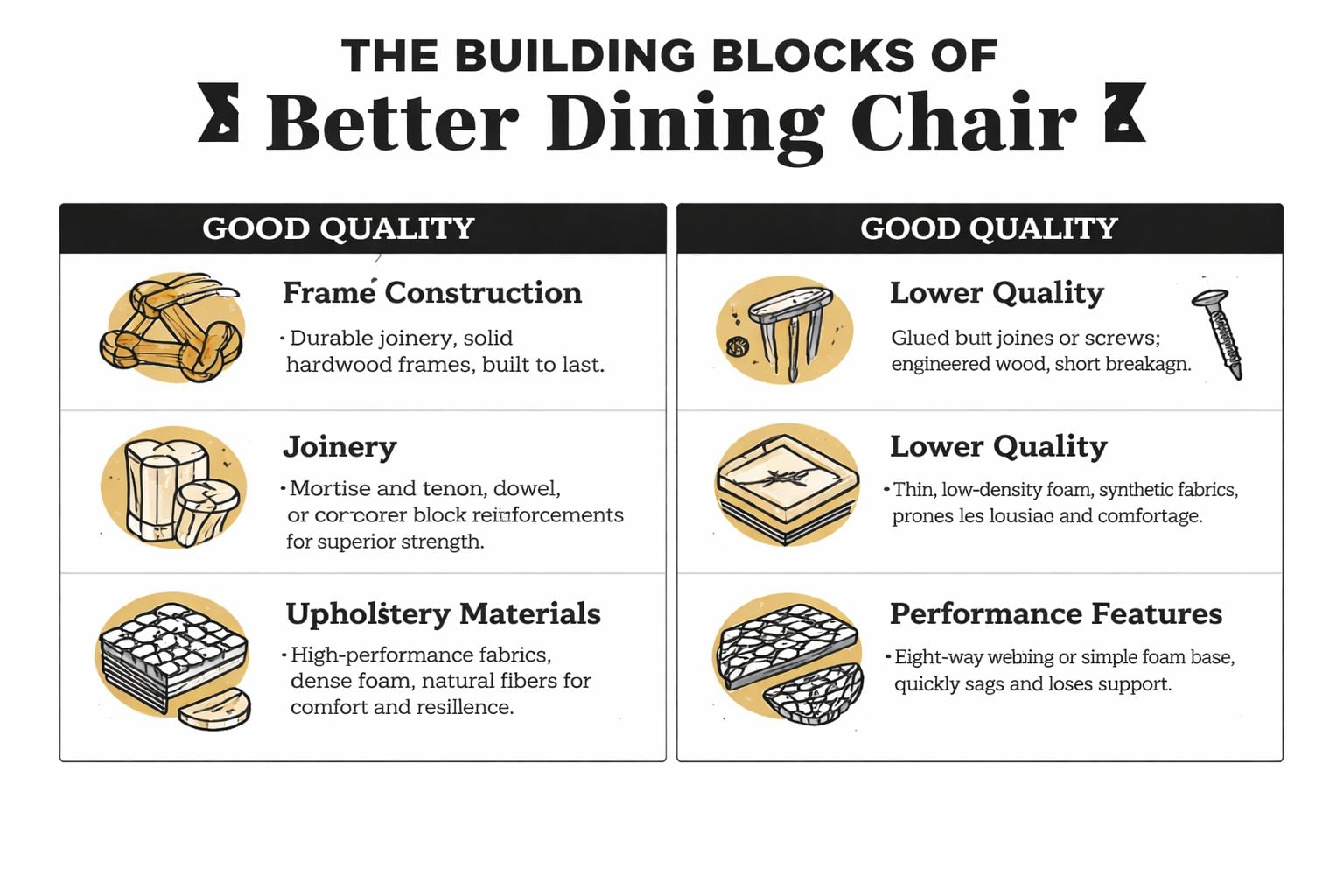
Here’s a simple visual comparison to anchor the basics.
Start with what you can’t see
The strongest dining chairs usually begin with better internal structure.
A solid hardwood frame matters because the chair absorbs constant motion. People don’t sit perfectly still. They lean back, shift side to side, and drag chairs across the floor. Better joinery helps the chair stay tight and steady over time.
If you enjoy furniture history, old workshop drawings and even vintage patent design prints can make that hidden engineering easier to appreciate. They remind you that a chair is both a design object and a working structure.
A quick construction comparison helps:
| Area | Better sign | Lower-quality sign |
|---|---|---|
| Frame | Solid hardwood | Lighter engineered parts |
| Joints | Reinforced joinery | Basic screws or weaker connections |
| Seat support | Built for repeated use | Feels soft at first, weak later |
| Upholstery | Dense materials with better wear resistance | Thin padding and surface-first fabric choices |
Upholstery is where family life shows up
In this situation, many Logan County families get practical fast.
You may love the look of a textured neutral fabric, but if the chair sits in a high-traffic home, performance matters more than trend. A useful benchmark comes from this upholstery guide, especially if you’ve never compared everyday fabric to performance fabric before.
The durability difference can be significant. According to Carrocel’s guide to custom dining chairs, high-performance fabrics can achieve over 100,000 double rubs on the Wyzenbeek test, which signals strong abrasion resistance for busy homes. The same source notes that full-grain leather has a tensile strength of 200 to 300 psi and can last 2 to 3 times longer than standard options when paired with quality frame construction.
That doesn’t mean every home needs leather or the heaviest-duty fabric available. It means you should match the material to your real life.
- For homes with kids. Easy-clean performance fabrics are often the calmer choice.
- For rooms used daily. Dense upholstery and sturdier seat support usually matter more than delicate detailing.
- For a more refined appearance. Leather can age beautifully, especially when you want a chair to develop character instead of staying uniform.
Parents often ask the same question in different words: “Will these still look good after regular life happens?” Materials won’t make a chair indestructible, but the right ones make daily wear much easier to live with.
Comfort isn’t just cushion
A plush seat can feel inviting for five minutes and disappointing after an hour.
Better dining chairs balance softness with support. You want padding that feels comfortable without letting you sink awkwardly or slide forward. A shaped back can help too, especially if your table gets used for homework, cards, or conversations that stretch long after the plates are cleared.
A strong chair isn’t only built to survive. It’s built to stay pleasant.
Finding Your Signature Style and Scale
Style decisions get easier when you stop asking, “What’s popular?” and start asking, “What belongs with my table, my room, and my routine?”
That’s the heart of custom dining chairs. You aren’t choosing a chair in isolation. You’re choosing the visual language around your table.
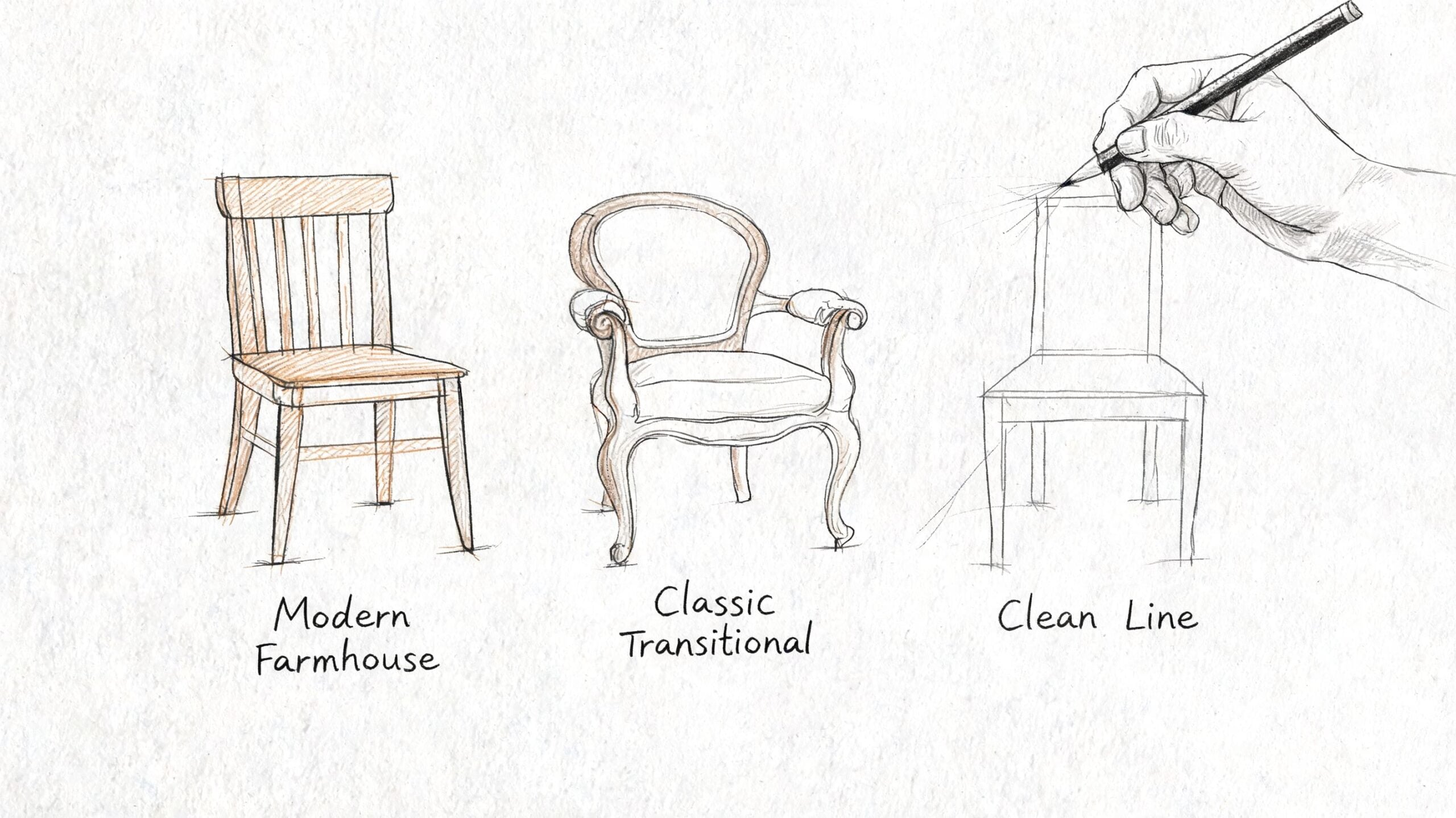
This sketch helps show how a few common directions can feel very different.
Three style paths people return to
Some readers know their style immediately. Most don’t. That’s normal.
If you need a broader design vocabulary first, this guide to explore interior design styles can help put names to the looks you’re already saving. Once you know the category, chair choices stop feeling random.
Here are three common directions:
Modern farmhouse
Usually warmer, more relaxed, and grounded in texture. Think wood tones, simple profiles, and upholstery that softens the room.Classic transitional
This sits in the middle. Clean enough to feel current, but with enough shape or tailoring to feel timeless.Clean contemporary
More edited and architectural. These chairs often rely on clear lines, slimmer frames, and fewer decorative details.
Why mid-century design still shows up everywhere
Many of today’s custom chair options still echo mid-century thinking. Brian Boggs Chairmakers’ design history explains that designers such as Hans Wegner, Charles and Ray Eames, and Norman Cherner helped establish the idea that dining chairs could be both highly stylized and practical for production. Wegner’s Wishbone Chair became widely recognized in the 1950s, and the Eameses pushed molded plywood techniques that changed how designers approached form and function.
The takeaway isn’t that you need a mid-century chair. It’s that this era taught manufacturers how to offer variation in finishes, materials, and silhouette without losing usability.
Some of the most successful dining chairs feel simple at first glance. Their appeal usually comes from proportion, not decoration.
Scale is where many rooms go wrong
A beautiful chair can still be the wrong chair.
Large chairs beside a narrow table make the whole room feel crowded. Tiny, delicate chairs next to a heavy trestle table can look accidental. Arms that flare outward may limit how many chairs fit. Tall backs may dominate a room with lower ceilings.
A few quick checks help:
- Stand at the doorway and look at the room as a whole. Do you want the chairs to soften the table, match it, or contrast with it?
- Notice leg shape and thickness. Heavy bases pair better with chairs that have enough visual substance.
- Think about what you see most often. In many dining rooms, the chair backs are the main visual feature.
Style should still answer practical questions
Before you settle on a silhouette, ask yourself:
- Do you want a chair that feels formal or forgiving?
- Will the seat be used only for meals, or for work and lingering conversation too?
- Does your room need visual softness, visual structure, or a little of both?
That last question helps more than people expect. Once you know what the room needs, the right style usually narrows itself.
A Practical Guide to Measuring for Comfort and Fit
This is the part that saves people from expensive frustration.
Many chair disappointments have nothing to do with color or style. The problem is fit. A chair may be too tall under the table, too deep for shorter sitters, or too wide to allow comfortable spacing.
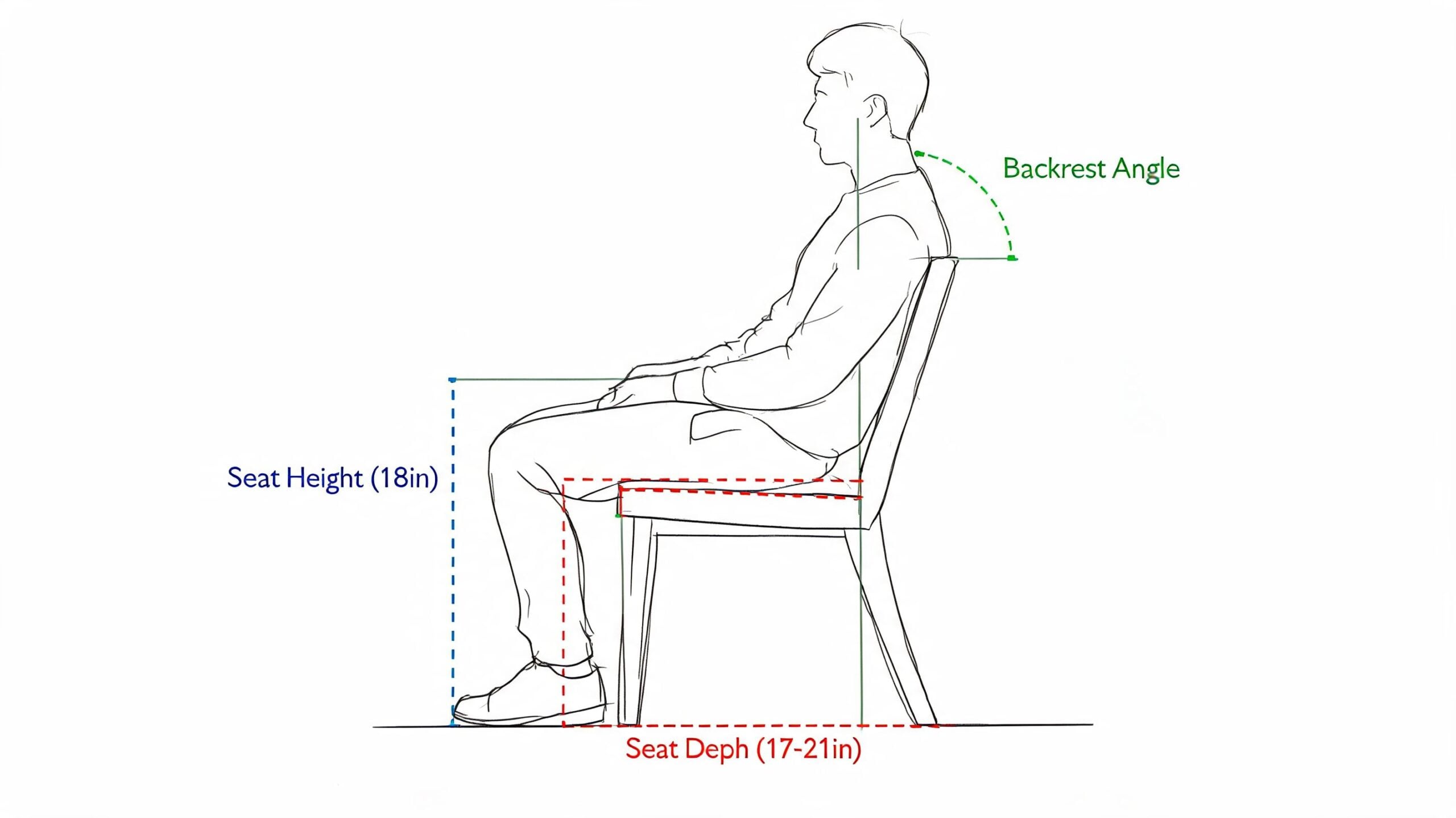
Keep this measurement diagram handy as you plan.
The key numbers that matter most
According to Picket & Rail’s dining chair dimension guide, a comfortable dining chair usually has a seat height of 17 to 19 inches, which allows 10 to 12 inches of leg clearance beneath a standard 28 to 30 inch table. The same guide notes that seat depth of 16 to 18 inches and seat width of 16 to 20 inches suit a wide range of body types and support longer sitting.
Those numbers aren’t rules meant to box you in. They’re guardrails that help you spot a bad fit before you order.
What to measure before you shop
If you want a smoother visit in store or a better online conversation, take these measurements first. This guide on how to measure furniture correctly is a useful companion if you want a full-room approach.
Bring these basics with you:
Table height
Measure from the floor to the underside of the tabletop, not just the top surface.Space between table legs or pedestal edges
This affects how many chairs fit and whether armchairs make sense.Available width per chair
Don’t just divide table length by the number of seats. Account for breathing room so people aren’t bumping elbows.Distance behind each chair
Make sure there’s enough room to pull out and sit down comfortably.
Measuring shortcut: Take photos of the room and table while you measure. A few phone photos often answer layout questions faster than a written note alone.
Comfort depends on who uses the chairs
A family with taller adults may prefer a slightly different feel than a home with children, grandparents, or mixed-height users. If the chairs double as work-from-home seating or game-night seating, back shape and seat depth matter even more.
That’s where custom options help. If you already know a standard chair feels too upright, too shallow, or too bulky, you can narrow your choices around that experience instead of repeating it.
Don’t forget arm height and visual clearance
Armchairs can be wonderful at a dining table, but they need a double check.
First, they need to slide under the table without hitting the apron. Second, they need to leave enough visual space that the room still feels open. In a compact dining room, even a comfortable chair can look crowded if the arms and back are too heavy.
A measured room usually leads to a calmer decision. You’re no longer hoping a chair will fit. You know what the room can handle.
The Tanger's Custom Journey From Our Showroom to Your Home
Saturday afternoon, you walk into our Bellefontaine showroom with three phone photos, the table you already own, and a question that sounds simple but rarely is. Which chairs will look right, feel right, and hold up in your home? That question is the start of the custom process, and a good process should make each decision clearer.
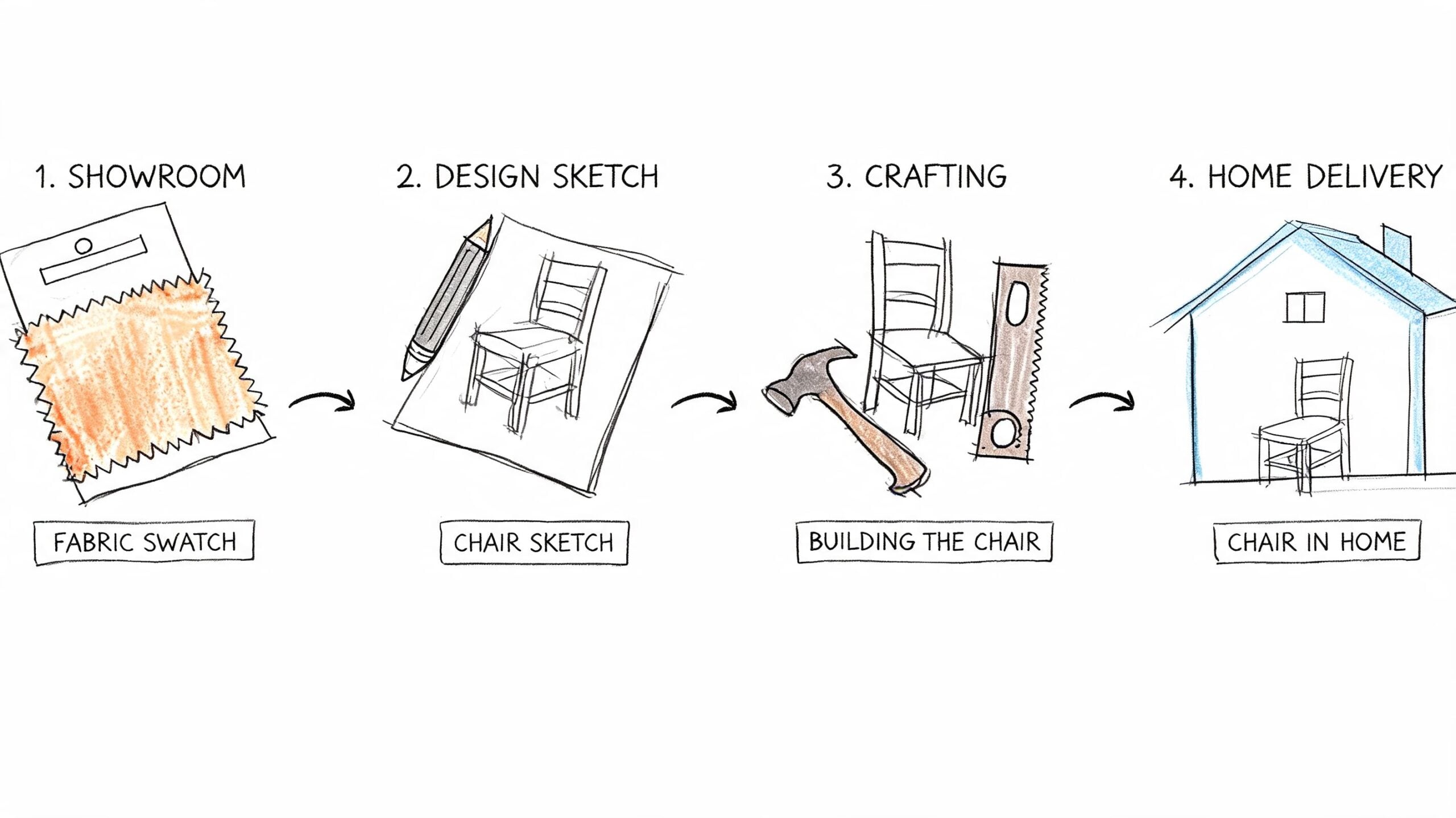
Custom ordering becomes much less intimidating once you can see the path. You do not need every answer before you arrive. Many families come in with a rough style direction, a budget range, and a few concerns about durability, color, or timing. Our job is to help sort those pieces into a chair you can order with confidence.
Step one feels hands-on because it should
Dining chairs are one of those furniture purchases that make more sense in person.
A fabric swatch works like a paint sample on a wall. On a screen, two fabrics can look nearly identical. In your hand, one may feel soft and relaxed, while the other feels tighter and more formal. Wood finishes are similar. A brown stain that looked perfect online can suddenly read too red, too dark, or too cool once it is next to your table or flooring.
That tactile part matters, especially for custom orders from trusted brands such as Flexsteel and Smith Brothers. National brand quality gives you confidence in the build. Local guidance helps you judge which option is the right fit for your home.
A good design conversation keeps the process organized
At Tanger's Furniture, a family business serving Bellefontaine and the surrounding area since 1946, the custom process usually begins with a practical conversation. What table are you keeping? Who uses the chairs every day? Do you want something refined and formal, or easygoing and forgiving? Those answers shape the order more than any trend board does.
Sometimes the decision is straightforward. You may only need help choosing between two seat backs and a durable upholstery. Other times, the chairs are part of a larger room update, and you want help coordinating with nearby upholstered pieces, wall color, or cabinetry so the dining area feels connected to the rest of the home.
A useful showroom discussion often covers:
How the chairs will really be used
Family meals, holiday hosting, homework, game nights, or a table that pulls double duty as a workspace.What is already staying
Your dining table, flooring, paint color, window treatments, or nearby case goods.How much upkeep feels realistic
Some households want fabric that hides daily life gracefully. Others are happy to do more upkeep for a specific look.What price range feels comfortable
It is easier to make smart choices when the budget is part of the conversation from the beginning.
Budget questions belong early in the process
Custom can sound expensive because it includes more decisions. In practice, those decisions often help you avoid paying for a chair that is almost right but never quite works. If spacing out the purchase would help, details on furniture financing options can give you a clearer picture of timing and monthly cost before the order is placed.
For busy families, that clarity matters. It turns custom from a vague idea into a plan.
If upholstery care is part of the hesitation, it helps to read a practical guide on how to clean upholstery without guessing on products or methods before you settle on a fabric.
Business spaces follow a similar path
The process is not limited to homes. Local offices, waiting rooms, and hospitality settings also need chairs that fit the room, support the brand image, and stand up to regular use. The questions change a little, but the planning is familiar. How will the seating be used? What finishes need to coordinate? What delivery timeline makes sense?
For those projects, Commercial Office planning support helps local organizations choose furniture with the same kind of care a homeowner would want for a dining room.
Ordering is only part of the journey
The last stage matters just as much as the first. Once your selections are finalized, the order is placed, production is scheduled, and delivery becomes part of the experience. Careful handling, clear communication, and setup in the home all help the project feel complete.
That local follow-through is part of what people want from a Bellefontaine store, not just a catalog. You get access to respected furniture brands, but you also get a nearby team that can answer questions before, during, and after the order.
Some households are updating more than one space at a time. A dining chair project may happen alongside a laundry replacement with Speed Queen laundry options or a bedroom refresh through a mattress store in Logan County. Real homes tend to change in stages, and a helpful store understands how those decisions connect.
Caring for Your Chairs and Our Lifelong Commitment
A custom dining chair should keep earning its place in the room long after delivery day. The finish should still look cared for. The seat should still feel supportive. The chair should still be the one people naturally pull up for a weeknight meal, a holiday gathering, or an extra conversation after dessert.
That kind of longevity usually comes from simple habits, done consistently.
Wood frames do well with a soft, dry cloth and quick attention to spills. Upholstered seats benefit from light vacuuming, especially along seams where crumbs and grit settle. Moisture is the main thing to avoid. If water or a spill sits too long, even a well-made chair can start to show wear sooner than it should.
Match the care routine to the material
Each material ages a little differently, much like different flooring types in a home. Hardwood, carpet, and tile all need care, but not the same care. Dining chairs work the same way.
- Wood frames stay in better shape when they are wiped gently and not dragged across the floor.
- Fabric seats usually clean up best when spills are blotted quickly instead of scrubbed in.
- Leather benefits from mild, routine care that keeps the surface from drying and stiffening.
If you are unsure which cleaner is safe, start with this upholstery cleaning guide for fabric furniture before reaching for whatever spray happens to be under the sink.
A well-made chair should grow more comfortable with use
One of the pleasures of custom furniture is how naturally it settles into daily life. A wood finish can gain warmth. Leather often softens. A good fabric choice can still feel inviting after years of dinners, homework sessions, and coffee with friends.
Small signs of use do not always mean something is wrong. They often mean the chair is being used as intended.
The test of a dining chair is not how it looks on the first day in your home. It is whether your family still chooses it comfortably and casually, year after year.
Support matters after the sale
Care at home is only part of the picture. If a question comes up later about fabric care, touch-up options, or service needs, it helps to have a local team that knows what you ordered and how it was built.
That is part of the difference between buying from a nearby family business and buying from a page on a screen. At Tanger's in Bellefontaine, families get access to respected custom lines such as Flexsteel and Smith Brothers, along with follow-through from a store that has been serving this area since 1946. National brand quality matters. So does having someone local who can answer the phone, look up your order, and help you keep your chairs in good shape.
Custom dining chairs are personal pieces. With the right care and dependable local support, they can stay comfortable, useful, and right for your home for many years.