Your Guide to a Dining Room Table Protector Pad

A dining table usually bears the marks of its service. It hosts weeknight dinners, school projects, coffee cups, holiday serving dishes, and the kind of conversations that make a house feel lived in. The trouble is that wood finishes and decorative tops don't get a day off, especially in busy homes around Bellefontaine and Logan County.
That's why a dining room table protector pad matters more than many shoppers first expect. It isn't just another accessory. It's a practical layer between everyday life and a surface that may be brand new, custom ordered, handed down, or too expensive to refinish casually.
Families who are already weighing furniture choices, whether they're shopping Bellefontaine furniture, comparing custom sofas Ohio shoppers often ask about, or even stopping in for Speed Queen laundry and a mattress store Logan County residents trust, usually want the same thing. They want the home to work hard without looking worn out too soon. A table pad fits that goal.
Table of Contents
- Protecting the Heart of Your Home
- Choosing Your Shield Materials and Styles Compared
- Measuring for a Flawless Fit Every Time
- Custom vs Ready-Made Which Pad Is for You
- Simple Tips for Cleaning and Long-Term Care
- Professional Protection for Your Business Space
Protecting the Heart of Your Home
A dining table often becomes the busiest work surface in the house, even when that wasn't the original plan. One day it's set for Sunday dinner. The next day it's holding homework folders, takeout containers, wrapping paper, and a laptop. That's exactly why surface damage usually happens gradually, then suddenly feels obvious.
A proper dining room table protector pad gives families breathing room. It helps guard against heat, moisture, scratches, and daily wear, which is why table pads have remained an established category in home furnishings. One industry guide describes table pads as the heavier, higher-protection option among dining table coverings, intended for surfaces in constant use, and notes examples that include magnetic construction and heat resistance rated up to 600 degrees in one product example from the category's marketplace, along with standard sizing for tables up to 80 inches long without leaves in another product description, showing how purpose-built and table-specific this category has become in real homes (industry guide on table pads and dining table protection).
For households planning a new dining setup, this same protect-first mindset belongs at the start of the process. Readers who are still comparing shapes, sizes, and seating arrangements may find this expert advice for your dining space useful before settling on a table and pad combination. It also pairs naturally with Tanger's own guidance on designing a dining room from the ground up.
A table pad works best when it's chosen as part of the table purchase decision, not as an afterthought after the first scratch appears.
In a family-owned store environment, that advice stays simple. Protect the piece that gathers the household. Whether the table is a heirloom cherry top or a new custom dining set, preserving the finish helps preserve the room's everyday comfort too.
Choosing Your Shield Materials and Styles Compared
Not every dining room table protector pad performs the same way. Some are built for occasional dinners. Others are built for homes where the table sees daily use and regular cleanup. The right choice depends less on appearance and more on how the household uses the room.
What protection actually matters
A high-quality pad is usually judged by thermal resistance, liquid barrier performance, and surface abrasion control. Category guidance also shows that many custom pads offer heat protection up to 550°F and use a waterproof surface with a soft flannel backing to reduce the chance of scratching the table finish.
That leads to a practical showroom rule. Shoppers should look past thickness alone. A thick pad that traps moisture, slides around, or has a rough underside can still create problems.
Most useful material questions to ask
- Heat habits: Does the table regularly hold hot serving dishes, casserole dishes, or coffee urns?
- Cleaning habits: Will someone wipe the pad after nearly every meal, or only now and then?
- Finish sensitivity: Is the table a softer wood, a high-sheen lacquer, or a darker finish that shows rub marks easily?
- Use pattern: Is this mainly for holidays, or will it stay on through homework, crafts, and daily meals?
Table Pad Material Comparison
| Material Type | Best For | Heat Resistance | Considerations |
|---|---|---|---|
| Heavy-duty vinyl surface with soft backing | Busy family dining tables, easy cleanup, frequent wiping | Often marketed with high heat protection on quality custom pads | Surface is easy to wipe, but buyers should still verify the actual heat rating and backing quality |
| Felt-backed or flannel-backed multi-layer pad | Wood tables that need scratch protection and a gentler underside | Depends on full construction, not backing alone | Good for finish protection, but fit and moisture management still matter |
| Magnetic pad systems | Households that want sections to stay aligned during use | Varies by product construction | Helpful for stability, but they still need correct sizing and material quality |
| Thin flexible cover styles | Light-duty use, occasional meals, simpler budgets | Usually more limited in real protection | Better than nothing for minor scuffs, but less dependable for hot dishes and everyday wear |
A rustic farmhouse table and a custom modern dining set don't need different principles. They need the same three protections done well. Heat resistance, liquid control, and a backing that won't abrade the finish are what count.
For households also protecting other wood pieces, Tanger's guide to protecting wood furniture from scratches and stains is a helpful companion read.
Practical rule: Match the pad to the messiest thing the table regularly handles, not the most careful version of household use.
Measuring for a Flawless Fit Every Time
A good table pad can fail for one simple reason. It's measured wrong. Most protection issues with custom pads start at the order stage, not after delivery.
The measuring method that prevents mistakes
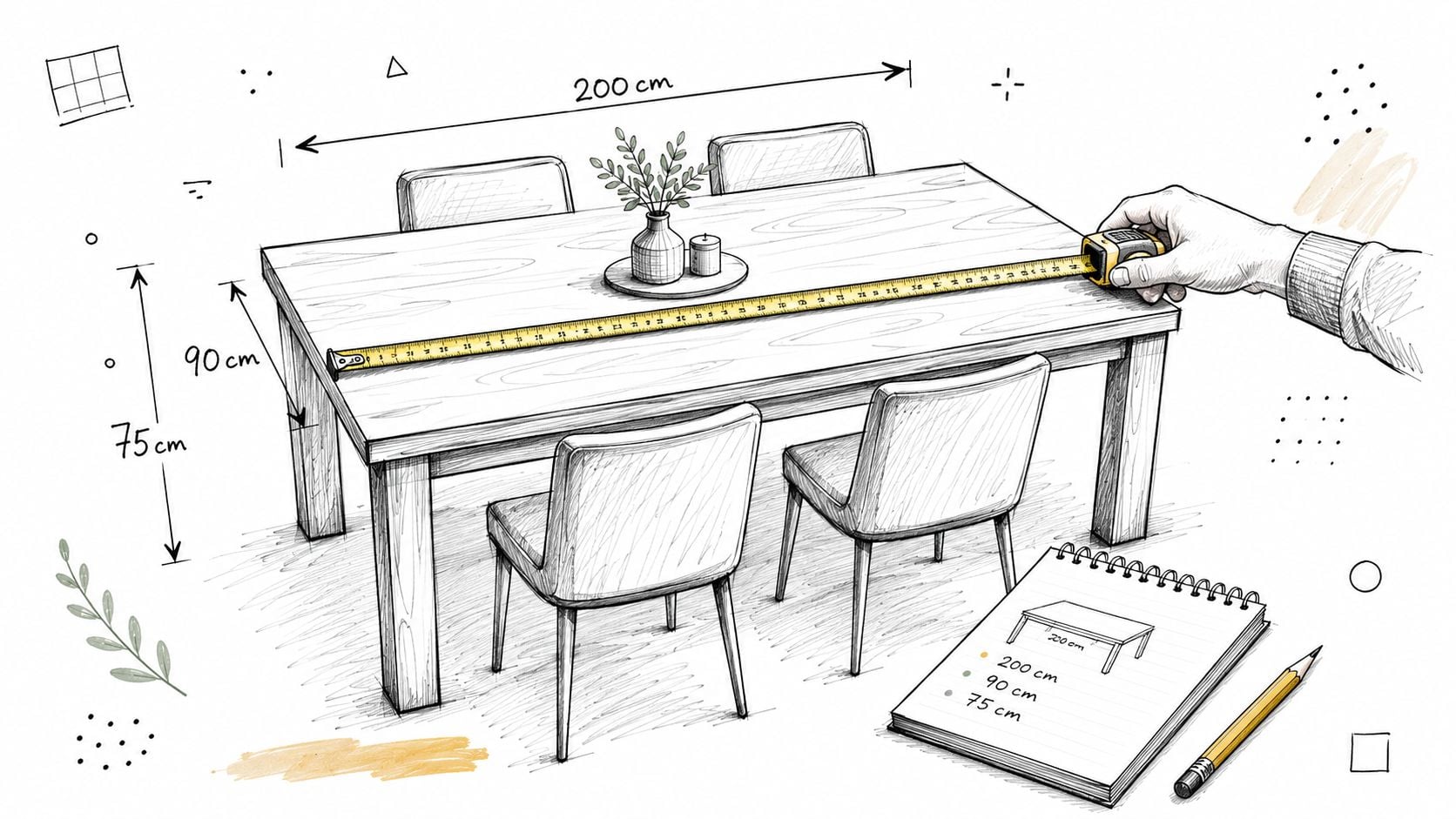
Custom guidance for dining table pads recommends measuring to the nearest 1/16 inch, using the table's full flat surface and including leaf width and corner radius, because dimensional errors are the main cause of poor protection (how to measure a custom dining table pad accurately).
That level of accuracy sounds fussy until the table has rounded corners, a bevel, or removable leaves. Then it becomes necessary.
Use this measuring checklist
- Start with the tabletop only: Measure the full flat surface, not the apron or skirt underneath.
- Use a metal flexible tape: Cloth tapes can drift and sag.
- Write dimensions immediately: Don't trust memory between width, length, and corner details.
- Include every leaf: If the table expands, measure each leaf width that needs protection.
- Capture the corners: Rounded corners and clipped corners need special attention.
- Note edge details: Bevels and shaped edges affect how the pad sits.
Shape-by-shape measuring notes
Rectangular tables are the most straightforward, but they still cause mistakes when people ignore corner radius or forget to include a leaf.
Round tables need a true diameter taken across the widest point of the usable top. If the edge profile changes where the flat area ends, the pad should match the surface that supports dishes and serving pieces.
Oval tables deserve extra care. Buyers should record overall length and width, then confirm whether the ends are true semicircles or a softer elongated oval.
If the shape is hard to describe, a bird's-eye photo with the tape visible usually clears up confusion faster than a long written note.
For unusual shapes, some manufacturers also use tracing methods to avoid mismatch. That's a smart route when the table has custom corners or irregular shaping. Households that want a second measuring reference can also review how to measure furniture for the home, especially when the dining project includes chairs, storage pieces, or a full room update.
Custom vs Ready-Made Which Pad Is for You
Saturday dinner is an easy way to test this decision. If the pad shifts when someone slides in a serving dish, leaves the edge exposed where hot plates land, or has to be folded and fussed with before every meal, it will not get used for long. A table protector should make life easier while guarding a surface that often holds the best hours of the week.
When ready-made makes sense
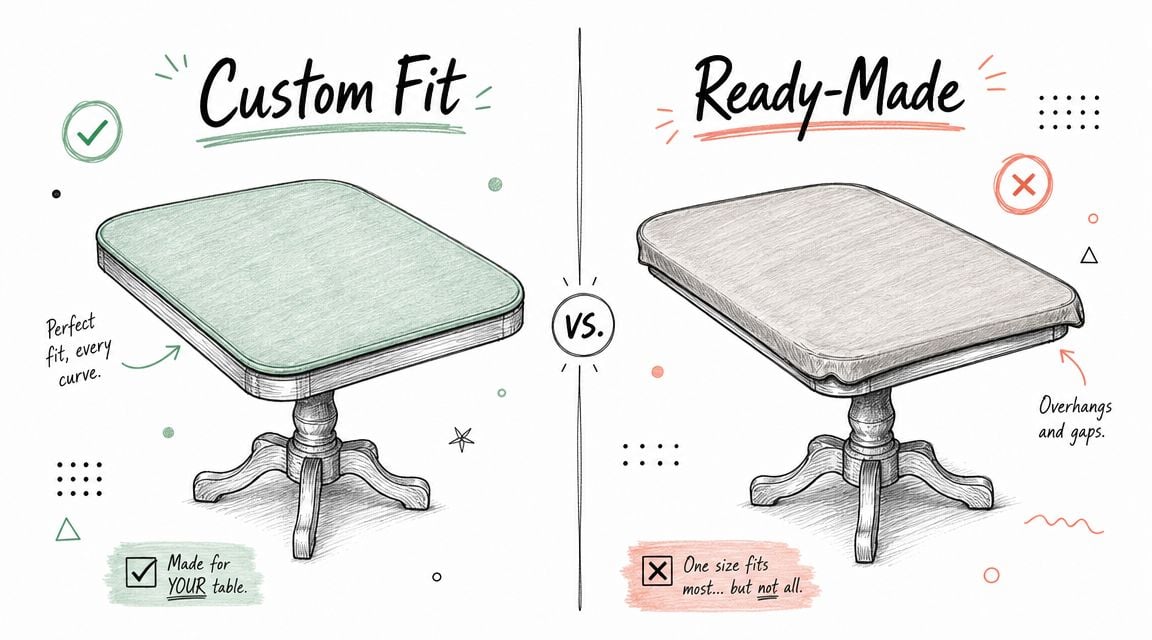
Ready-made pads earn their place on straightforward tables and tighter budgets. If the table is a standard rectangle or round shape, sees occasional use, and is not a sentimental piece, a stocked size can be a practical answer.
Speed matters too. Some households need protection now for a rental, a breakfast nook, or a craft table that gets hard use but not much ceremony. In those cases, a near fit may be good enough.
Ready-made usually works best when
- The shape is standard: Simple rectangle or round tops are easier to match
- The table stays the same size: No leaves to cover and store
- The setting is casual: Everyday utility matters more than a perfect fit
- The table is lower risk: A small gap at the edge is less troubling on a less delicate finish
When custom is worth it
Custom pads make more sense when the table matters more. That could mean an heirloom handed down through the family, a new custom dining set, or the main table where homework, holidays, and weeknight meals all happen.
Published pricing from a table pad maker shows a basic custom dining table pad commonly falls between $269 and $414, and adding one leaf raises the cost by about 20% to 25% (published table pad pricing and leaf cost structure). For many families, that cost is easier to justify when compared with refinishing a damaged top or watching wear build up on a table they plan to keep for years.
A custom pad usually earns that extra cost in day-to-day use. It sits flatter, covers the edges correctly, and handles expansion leaves without awkward gaps. Those details matter most on the table that anchors the room.
Custom is often the better choice for
- Expandable tables: Separate sections can be made to fit leaves correctly
- Heirloom or premium furniture: Better edge coverage helps protect value and finish
- Frequent entertaining: A better fit stays in place during heavier use
- Made-to-order dining rooms: Protection can match the same care given to the furniture itself
Families already planning a personalized dining setup usually follow the same thought process they use for upholstery, finish, and sizing. The steps are similar to getting started with custom order furniture.
Local furniture stores can often help place custom pad orders as part of a larger dining room project. At Tanger's Furniture, for example, custom table pads are one of the categories that can be coordinated alongside dining tables, chairs, and room planning.
One practical note. Some ready-made silicone-style protectors are easier to wipe down after messy projects, and the same care habits covered in this silicone mat cleaning guide can help households judge whether that material fits their routine.
Simple Tips for Cleaning and Long-Term Care
A pad can be built well and still age poorly if it's cleaned the wrong way or stored carelessly. Long-term performance depends on daily habits more than commonly realized.
Daily habits that help
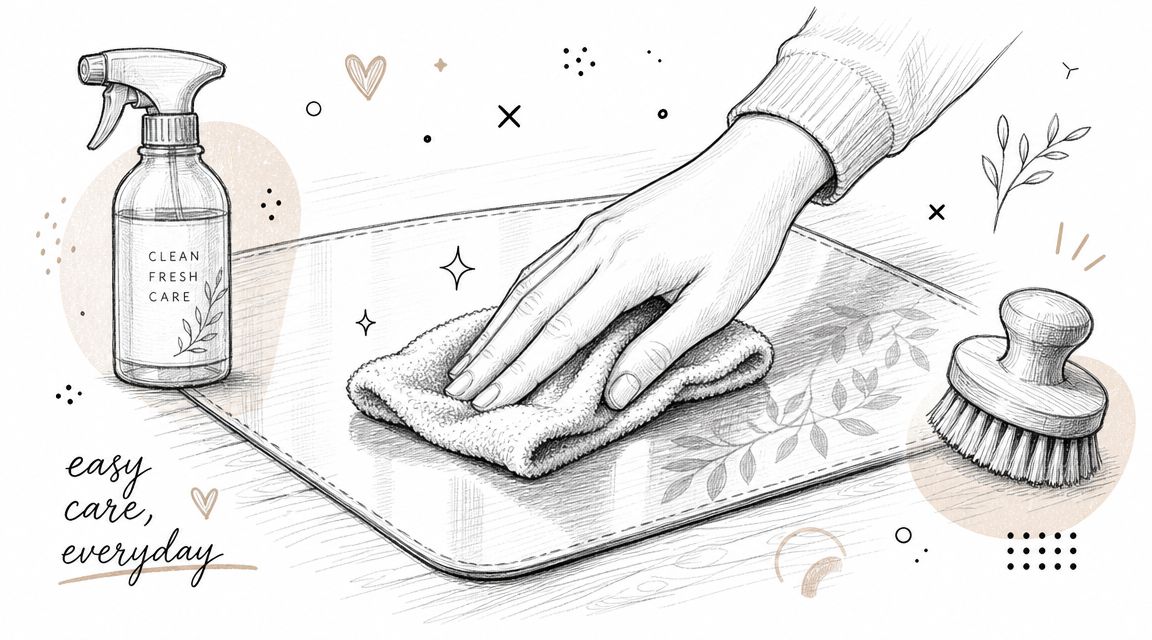
Real-world use involves more than initial protection. Buyers should think about how the material handles repeated wiping, odor retention, and whether trapped moisture could affect the table finish over time (care considerations for repeated cleaning and moisture exposure).
That's why simple cleanup habits matter.
Good care habits
- Wipe spills promptly: Don't let liquids sit along seams or edges.
- Use gentle cleaners: Harsh products can leave residue or affect the surface feel.
- Dry before covering for long periods: Any lingering moisture between pad and table is asking for trouble.
- Check the underside too: Dust or grit underneath can act like sandpaper over time.
For households that like a straightforward cleaning routine, some of the same habits used for wipe-clean kitchen surfaces apply here. This silicone mat cleaning guide offers a useful reminder that mild cleaning and thorough drying usually beat aggressive scrubbing.
Storage and material watchouts
Pads often spend part of the year off the table, especially after holidays or big gatherings. Storage matters.
Store with care
- Keep sections aligned: Don't force them into awkward bends.
- Choose a dry area: Damp basements and humid storage rooms can create problems.
- Avoid stacking sharp items on top: Pressure marks can change how the pad lies.
- Inspect before seasonal use: A quick look at seams and backing prevents surprises.
A clean pad protects better than a dirty one, but a dry pad protects better than a merely clean one.
This is also where full-service support matters in a broader home project. Families often appreciate knowing local teams can handle delivery, setup, and later service questions across the home, whether the purchase is dining furniture, case goods, or even a new laundry setup.
Professional Protection for Your Business Space
Professional spaces put hard, daily wear on tables. A conference room surface might host a laptop in the morning, catered lunch at noon, signed paperwork in the afternoon, and a rushed cleanup before the next meeting. In our store, that is usually the point where business owners realize a good table needs protection from day one, not after the finish starts showing it.
The pressure is different in a workplace than it is at home. Shared use means more dragging, more wiping, more heat, and more chances for small damage to become visible across the whole room. A nick on a boardroom table or reception surface changes how the space feels to staff, clients, and guests. For many businesses, that table is part of the first impression.
Where business surfaces need more protection
Conference tables, breakroom tables, hospitality counters, training room surfaces, and client-facing furniture all see repeated contact. Staff slide laptops across them, guests set down drinks, deliveries land on them, and cleaning crews need fast access between uses. Even careful teams create wear over time because the schedule is tight and the furniture rarely gets a break.
Some rooms need a pad because they face constant traffic. Others need one because replacement would be expensive, disruptive, or both.
Commercial spaces that benefit from protective planning
- Conference rooms: Heat from mugs, cable boxes, laptops, and frequent chair movement around the table
- Break areas: Food spills, repeated wiping, and heavy shared use throughout the day
- Reception and waiting areas: High visibility and constant contact from visitors and staff
- Training rooms: Furniture that gets moved, reset, and used by different groups back to back
Cleaning also tends to be more aggressive in commercial settings, which changes the protection plan. Staff should know the difference between routine surface care and sanitation standards. Businesses reviewing cleaning methods may find this overview of commercial kitchen sanitiser options helpful for broader surface-care decisions.
Why commercial planning matters
Business buyers usually need more than a pad alone. They need the right table shape, a finish that fits the workload, and surface protection that does not make the room look temporary or overly covered. That balance matters in offices, hospitality settings, and shared work areas where appearance and durability have to work together.
Tanger's offers commercial interior design services for business spaces that help owners plan layouts, furnishing choices, and long-term use. We have seen the same principle hold true for both family dining rooms and professional settings. Protect the surface early, match the material to the job, and choose furniture that can handle real use without asking for constant repair. That approach keeps a workspace looking cared for and helps the investment last longer.