Deep Seat Sectional Sofa: Your Ultimate Comfort Guide


A long workday ends. Shoes come off at the door, the family gathers in the living room, and the old sofa suddenly feels too shallow, too stiff, and too small for real life. One person wants to stretch out, another wants to curl up with a blanket, and the dog has already claimed the best corner.
That's usually the moment a deep seat sectional sofa starts sounding less like a trend and more like the right answer.
In homes across Bellefontaine and Logan County, comfort often has to do more than look good. It has to hold up to movie nights, naps, visiting relatives, and the everyday rhythm of people who want a room to feel lived in, not staged. For first-time buyers, the category can also get confusing fast. “Deep seat” sounds simple until seat depth, room scale, support, and delivery access all enter the picture.
A family-owned furniture business with roots going back to 1946, and design history serving the area since 1964, learns pretty quickly that the best advice is honest advice. Some shoppers will love a deep seat sectional sofa the second they sit down. Others need a few practical adjustments, or a different configuration entirely, to get the comfort they expect.
That's why the smartest way to shop isn't to chase buzzwords. It's to understand how these sectionals work, who they fit best, and what details people often miss before they buy.
Welcome to the Coziest Seat in the House
A deep seat sectional sofa usually enters the conversation when a standard couch stops meeting real-life needs. A growing family wants more room. A taller homeowner is tired of knees hanging over the cushion edge. A couple wants one seating piece that can handle guests on Friday and a lazy Sunday afternoon the next day.
That appeal has grown well beyond a niche style. In 2025, sectional sofas held the largest product type share of the total sofa market at 28.76%, within a sofa market valued at USD 104.7 billion, according to industry analysis from Mordor Intelligence. The same analysis notes that buyers have moved toward deep-seat comfort and modular designs, and the broader sofa market reached USD 109.9 billion in 2026, with a projection to reach USD 144.5 billion by 2031 at a 5.6% CAGR.
That shift makes sense in everyday terms. People aren't only shopping for a place to perch upright for twenty minutes. They're shopping for a piece that supports how they live.
Why deep seating feels different
A regular sofa often works like a dining chair in soft form. It keeps the body more upright, which can be useful for formal sitting or short conversations. A deep seat sectional sofa changes the posture completely. It invites lounging, not perching.
Deep seating tends to feel less like “sit properly” furniture and more like “stay awhile” furniture.
That's one reason these sectionals work so well in family rooms, finished basements, media rooms, and open-concept homes. They create a place where several people can spread out without feeling packed together.
Where this style fits best
A deep seat sectional sofa often works well for:
- Tall users: Extra depth gives longer legs more room to rest naturally.
- Loungers: People who read, nap, or watch movies on the sofa usually appreciate the relaxed posture.
- Busy households: A sectional can gather the whole family in one spot.
- Statement rooms: Large seating helps anchor open spaces and gives the room a welcoming center.
For local shoppers browsing Bellefontaine furniture, custom sofas Ohio options, or even unrelated essentials like Speed Queen laundry appliances and a mattress store Logan County search, the same basic goal tends to show up again and again. They want a home that works better every day, not just something that looks nice on the sales floor.
What Exactly Is a Deep Seat Sectional
A deep seat sectional sofa isn't just any oversized couch. It has a specific dimensional difference that changes how the body sits and relaxes.
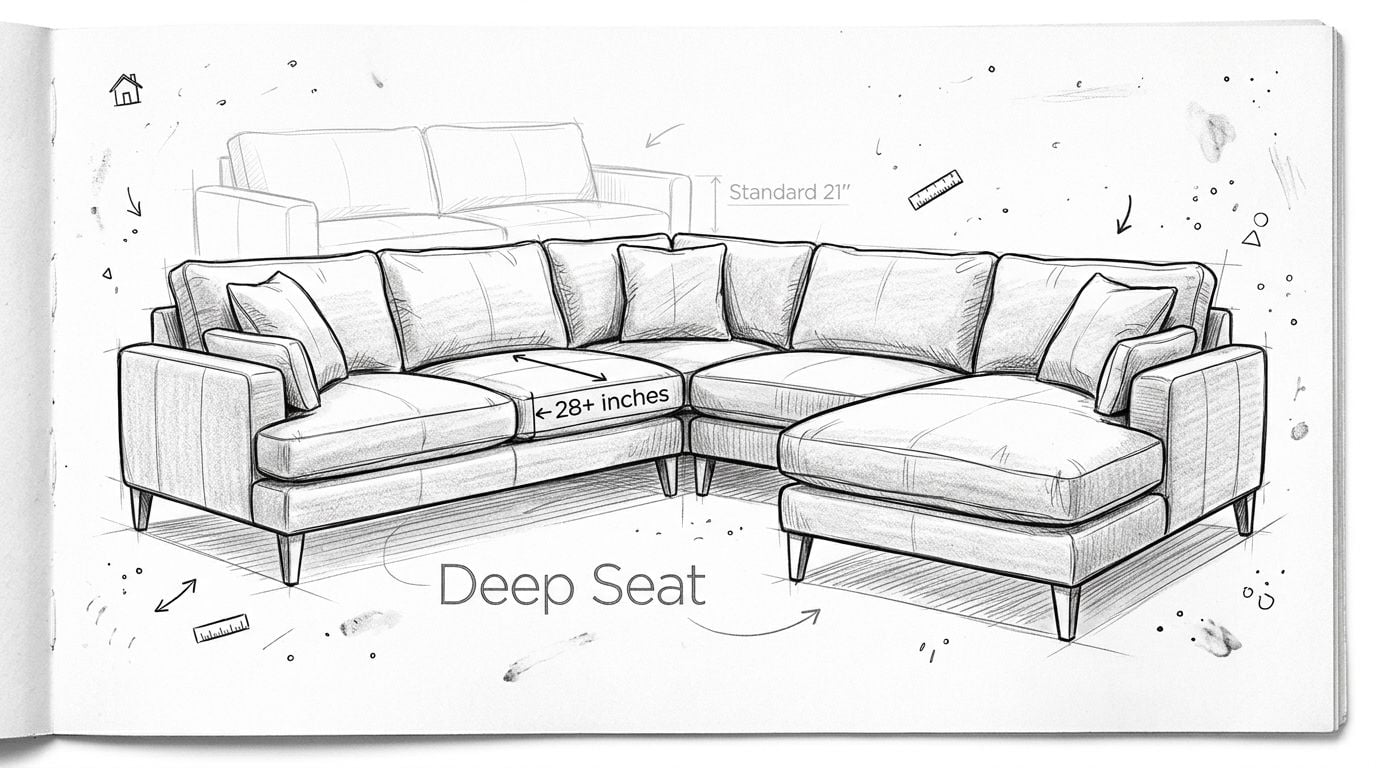
According to DreamSofa's guide to deep seat sectionals, a deep seat sectional sofa is defined by a seat depth ranging from 28 inches to over 35 inches, compared with a standard sofa seat depth of 20 to 22 inches. That extra depth supports a more relaxed, sinking posture that's better suited to lounging than upright sitting.
For readers who want another visual way to compare oversized silhouettes and casual lounging setups, The Sofa Cover Crafter's deep sofa recommendations can help make the category easier to picture.
A good companion read is also this sectional buying guide, which helps decode layout and fit decisions before a final purchase.
The simplest way to understand seat depth
Think of the difference between a desk chair and a lounge chair.
A desk chair keeps the body closer to upright because the seat is shallower and the posture is more active. A deep seat sectional sofa does the opposite. The body sits farther back, the legs can stretch more, and the posture becomes more casual.
That one change affects several things at once:
- Body position: More cushion in front of the hips changes how a person settles into the seat.
- Use case: Lounging, reading, napping, and movie watching become easier.
- Visual feel: The sofa looks softer, broader, and more relaxed in the room.
Why the extra inches matter
The extra depth isn't just a style choice. It changes how the sofa performs.
In the verified sizing range, the seat extends well beyond what a standard sofa offers. That creates more horizontal room for folded legs, side lounging, or stretching out without immediately needing an ottoman. For many households, that's the feature that turns a sofa into the most-used spot in the home.
A deep seat sectional sofa often suits:
| User or household | Why it works |
|---|---|
| Taller adults | More leg room and a less cramped sit |
| Families with kids | Easier to share one seating area |
| Readers and nappers | Better support for relaxed positions |
| Open floor plans | Larger scale helps define the room |
Practical rule: If the main goal is upright seating for short conversations, a standard depth may feel better. If the main goal is settling in for hours, deep seating usually wins.
The Real Pros and Honest Cons of Going Deep
A deep seat sectional sofa can be wonderful. It can also be a mismatch if comfort is defined differently by the people using it. That's why the honest answer isn't “deeper is always better.” The honest answer is “deeper is better for some bodies, some rooms, and some habits.”
What people usually love
The biggest advantage is obvious the moment someone sits down. Deep seating creates a relaxed, generous sit that encourages the body to settle in.
Common benefits include:
- Lounging comfort: It supports movie nights, reading, napping, and sprawling out.
- Shared seating: A sectional gives families and guests room to gather without squeezing shoulder to shoulder.
- Soft visual impact: Deep, low-profile seating often makes a room feel inviting instead of formal.
- Flexible styling: Throw pillows can change both the look and the usable depth.
There's also strong market movement behind this category. The global sectional sofa market was valued at $22.4 billion in 2025 and is projected to reach $36.8 billion by 2034 at a 5.2% CAGR, according to Market Intelo's sectional sofa market report. That same report notes growing interest in large, reconfigurable sectionals with statement design.
For pet households, material choice matters just as much as seat depth. A practical guide on choosing fur-free fabrics can help narrow down upholstery that looks cleaner between deeper cleanings. Readers can also compare comfort features in this overview of sectional details to look for.
Where buyers get surprised
The most overlooked issue is ergonomics for average-height adults.
According to Chita Living's seat depth guide, deep seat sectionals in the 25 to 30+ inch range often fail the ergonomic “feet flat” test for average-height users from 5'4" to 5'10". For that group, the ideal seat depth is often 21 to 22 inches. On a deeper seat, feet may not rest flat comfortably, which can push the body into slouching or edge-sitting unless extra back support is added.
That doesn't make deep seating bad. It just means the buyer should match the sofa to the user.
The Knee Bend Test
A simple showroom rule helps here. Sit all the way back. Then check what the knees and feet are doing.
- Good sign: Feet rest flat and the lower back still feels supported.
- Warning sign: Legs dangle, knees lift too much, or the sitter scoots forward to feel stable.
- Easy fix: Add substantial back pillows, a kidney pillow, or choose a model with supportive lounge backs.
Average-height shoppers shouldn't assume “more depth” equals “more comfort.” Without support behind the back, a very deep seat can feel great for lounging and awkward for everyday upright sitting.
One more honest drawback
Scale can overwhelm a room if the sectional is oversized for the floor plan. A large piece can make a modest living room feel crowded, especially if traffic paths get pinched or the coffee table ends up too far away to use comfortably.
That's where careful measuring matters most.
How to Measure Your Space and Avoid Delivery Headaches
Most buying mistakes happen before the sofa ever reaches the living room. The floor space gets measured. The doorway doesn't. Then delivery day arrives, and the largest piece won't turn the corner.
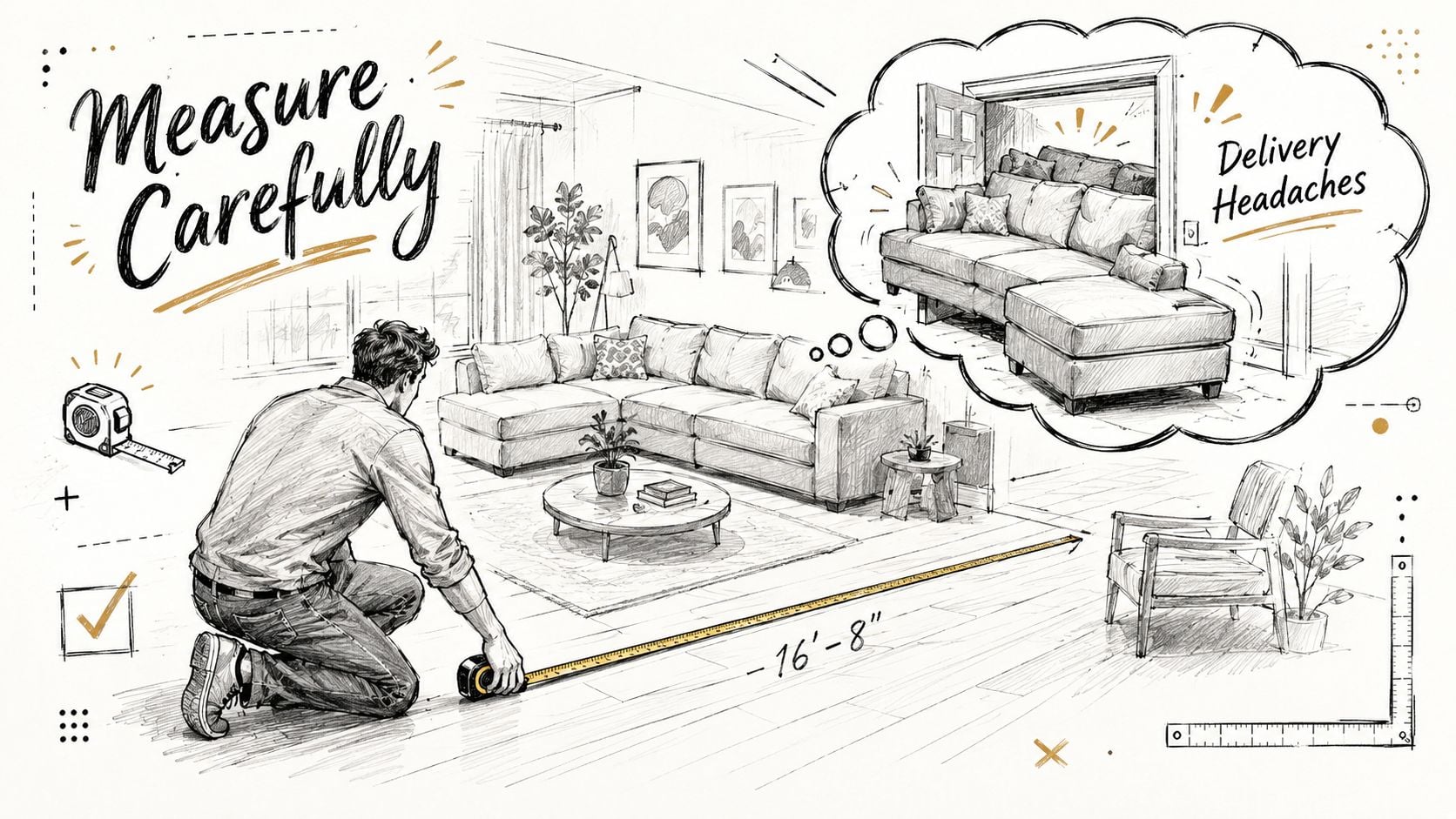
That problem shows up often with deep sectionals because their footprint is substantial. Coleman Furniture's sectional dimension guide notes that deep seat sectionals commonly have an overall depth of 35 to 42 inches, with chaise extensions reaching 60 to 72 inches or more. The same guide recommends maintaining 30 to 36 inches of walkway clearance and notes that sectional widths often range from 95 to 156 inches, depending on configuration.
Start with the room, not the product tag
Before picking a shape or fabric, measure the room in a way that reflects real living.
Use this checklist:
- Mark the seating zone with painter's tape on the floor.
- Measure walking paths around the sectional footprint.
- Check coffee table space so the room doesn't feel jammed.
- Look at sightlines to windows, fireplaces, and televisions.
A larger sectional can work beautifully in a compact home if the traffic flow still feels natural. It can feel miserable in a larger room if it blocks movement.
Don't skip the Delivery Diagonal
Many guides stop at room width and depth. That's not enough.
According to Sierra Living Concepts' sofa dimension article, many buyers miss the “diagonal depth” of the largest sectional piece relative to narrow doorways that are often 30 to 32 inches wide, and this issue causes up to 30% of deep seat sectional returns due to delivery failure. Deep sectionals are often 94 to 156 inches long, with chaise projections of 60 to 72 inches, which makes turning them through tight halls and older entries especially difficult.
That's the blind spot that matters in many older Logan County homes. Front doors may be manageable, but interior hallways, stair landings, and basement turns can stop a delivery cold.
A useful local planning step is this furniture measuring guide, which helps shoppers check access points before scheduling delivery.
Bring the sofa dimensions to the house, then trace the entire path from truck to room. The living room opening isn't the only obstacle.
The measurements that matter most
A buyer should record:
- Doorway width and height
- Hallway width
- Stairwell width and ceiling clearance
- Turn space at landings
- Diagonal path through tight corners
- The largest single piece measurement, not just the total sectional size
This matters even more with custom-order furniture, because returns are harder when the piece is built for a specific home.
A practical fit table
| Area to measure | Why it matters |
|---|---|
| Front and side doors | Entry may be tighter than expected |
| Hallways | Depth of the piece affects turning clearance |
| Stairwells | Tall backs and deep frames can bind on angles |
| Room walkways | Everyday comfort depends on open circulation |
| Largest module | Delivery success depends on the biggest piece |
Designing Your Dream Sectional The Tangers Way
A deep seat sectional sofa is easiest to love when it fits the household instead of asking the household to adapt to it. That's where customization matters.
A one-size-fits-all sofa usually forces compromises. The fabric may be wrong for pets. The seat may be right, but the arm style may feel bulky. The layout may fit the room, but the cushion feel may be too soft or too firm. Custom ordering solves those little conflicts before they become daily annoyances.
For shoppers exploring custom sofas Ohio options, this custom order starting point shows how a guided process can make a big purchase feel simpler, not more complicated.
Why customization matters with deep seating
Deep sectionals are especially personal because comfort isn't universal. One home wants sink-in softness for movie nights. Another wants a more supportive sit that still feels generous. Some need performance fabric for kids, while others want leather that develops character over time.
That's why brand partners with broad customization menus are so valuable. Smith Brothers of Berne offers over 800 premium fabrics and 100 top-grain leathers for custom sofas, along with choices for arm styles, back styles, cushion firmness, and leg finishes. That level of personalization helps buyers tune both the look and the feel.
Flexsteel also offers select customizable pieces with over 100 fabric options and 50+ finishes, including high-performance fabrics rated for 35,000+ rub cycles for demanding households with children or pets.
What buyers can tailor
A custom deep seat sectional sofa usually lets the shopper make decisions in layers:
- Layout first: Left chaise, right chaise, corner sectional, or modular arrangement.
- Comfort second: Seat feel, back support, and cushion firmness.
- Material third: Fabric, leather, or performance upholstery based on lifestyle.
- Detail last: Arm shape, leg finish, and visual style.
This doesn't have to feel overwhelming when the process is guided well. It should feel like narrowing toward the right answer.
The best custom piece doesn't shout “custom.” It quietly fits the room, the family, and the way the home is used every day.
The practical side people appreciate
Customization only works when the service around it is dependable. Buyers usually care about the sofa itself first, but the process around it matters just as much.
That means paying attention to the full purchase experience:
- Value: A Low Price Promise gives shoppers confidence that customization doesn't have to mean overpaying.
- Flexible payments: Financing helps families spread out larger projects without settling for the wrong piece.
- Delivery help: Professional local delivery takes the heavy lifting off the homeowner.
- Ongoing support: In-house service requests make post-delivery issues easier to handle.
- Commercial needs: Business owners furnishing waiting rooms, offices, or collaborative spaces often need the same durability and planning support as residential clients.
For professional buyers, deep seating can also work in lounge areas, hospitality settings, and collaborative office zones. A soft seating plan paired with durable upholstery can make a workspace feel more welcoming without losing function. That's where commercial office planning and space layout support become especially helpful.
Styling Your Deep Seat Sectional Like a Pro
Once the sectional is in place, styling should do more than decorate. It should help the sofa function better.
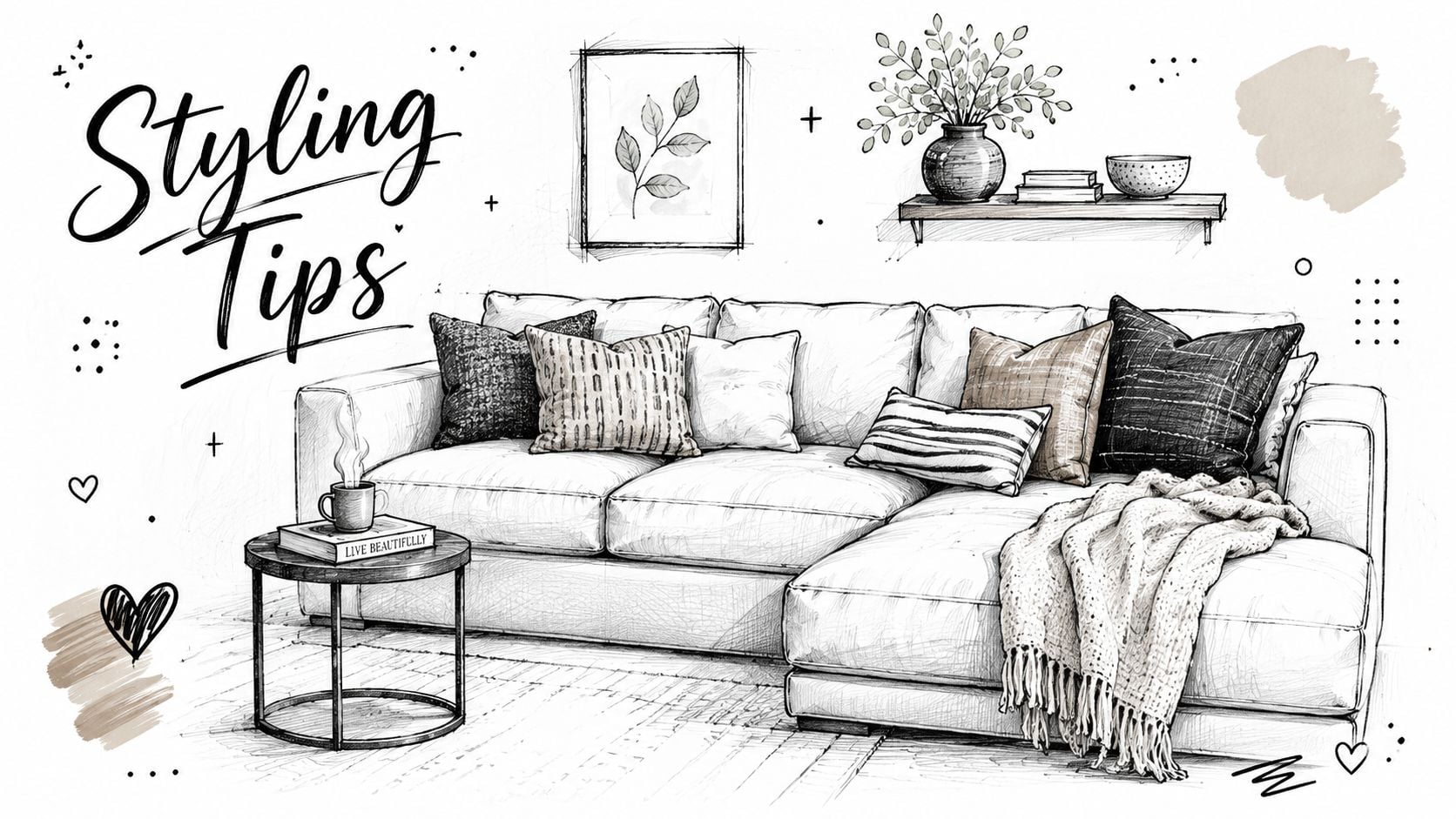
A deep seat sectional sofa has visual weight. If the surrounding pieces are too small, the room looks off-balance. If accessories are chosen well, the same large sofa feels polished and easy.
A helpful companion for tabletop finishing is this coffee table styling guide. For maintenance planning after the room is finished, some homeowners also like to find local upholstery cleaning before spills and heavy use become a problem.
Three styling moves that help immediately
- Use pillows as fit tools: On a deep seat sectional sofa, throw pillows aren't just decorative. They can shorten the sitting depth for guests who prefer more upright support.
- Choose a rug with enough presence: A small rug under a large sectional makes the whole room feel skimpy. The rug should visually anchor the seating area.
- Match table scale to sofa scale: A tiny coffee table gets lost in front of a large sectional. An ottoman or broader table often works better.
Placement matters more than people think
There are two reliable placement strategies.
One is to float the sectional in the room. That works well in open-concept spaces where the sofa helps define a living area. The other is to nestle it into a corner, which often makes sense in more compact rooms where every walkway matters.
A buyer should ask one simple question before deciding. Is the sectional meant to divide space or maximize space?
A simple styling guide
| Styling element | Best approach |
|---|---|
| Pillows | Mix comfort pillows with firmer support pillows |
| Rug | Size it to anchor the full seating zone |
| Coffee table | Choose a scale that matches the sectional's footprint |
| Lighting | Add floor or table lighting near the chaise or corner seat |
| Blankets | Keep one within reach so the sectional feels lived in |
A deep sectional looks best when the room around it feels intentional, not crowded.
Make comfort part of the look
The smartest styling choice is often the most practical one. Keep a few larger back pillows nearby. They help shorter guests sit comfortably without losing the lounge-friendly feel that makes deep seating special in the first place.
That balance is what makes a room feel finished. It looks welcoming, and it works for different people.
Frequently Asked Questions
How long does a custom deep seat sectional sofa take?
Custom orders usually require patience. According to this custom sofa timing guide, most custom sofas and sectionals take between 6 and 12 weeks to manufacture, and more complex designs with recliners or added tech features can take closer to three months before shipping begins.
Is a deep seat sectional sofa good for everyday use?
Yes, if the seat depth matches how the household sits. Homes that lounge, stretch out, and gather casually often love deep seating. Homes that mostly want upright support may need added back pillows or a less dramatic depth.
What's the biggest mistake people make before buying?
They measure the room but not the delivery path. That includes doorways, hallways, stair turns, and the largest individual piece of the sectional.
Can a deep sectional work for shorter people?
It can, but support matters. Pillows behind the lower back often make a big difference for average-height users who want the soft look of deep seating without feeling swallowed by it.
Is custom upholstery worth it?
For many households, yes. It lets the buyer choose a fabric, layout, and comfort level that fits the room and daily life better than an out-of-the-box option.
What if the project isn't just for a home?
The same planning principles apply in professional spaces. Offices, lounges, waiting rooms, and shared areas often benefit from durable upholstery, thoughtful layout planning, and flexible payment options.
Visit the showroom in Bellefontaine to see custom options in person or browse the collections online at Tanger's Furniture to start the journey. Shoppers looking for Bellefontaine furniture, custom sofas Ohio expertise, a mattress store Logan County partner, or even dependable Speed Queen laundry solutions can also ask about the Low Price Promise, flexible financing for any project, local delivery, and in-house service support that handles the heavy lifting from start to finish. Have a specific design question? Contact the design staff today or join the Love Your Home Club for expert tips and exclusive offers delivered to the inbox.