Dining Room Sets Solid Wood: Your 2026 Buying Guide


Saturday afternoon in Bellefontaine has a way of turning a simple furniture search into a full family debate. One person wants a table that'll survive homework, holiday platters, and the occasional dropped fork, while someone else is staring at grain pictures online and wondering why two “wood” tables look nothing alike. That's exactly why dining room sets solid wood still matter, the label sounds simple, but the buying decision is about construction, size, finish, and whether the piece fits how a Logan County home runs.
Solid wood earns its place because people want furniture that lasts, can be repaired, and still looks right after years of daily use. Consumer preference backs that up, too. An American Home Furnishings Alliance report cited in industry coverage says about 70% of consumers prioritize durability and longevity when selecting dining furniture, and surveys also show over 70% are willing to pay more for sustainably sourced wooden products (industry coverage). That combination of longevity and sustainability is why this category keeps its footing even as styles change.
Why Solid Wood Dining Sets Remain the Gold Standard
A family can walk into a showroom thinking they only need a table, then end up comparing finishes, leaf options, and claims about what is inside the frame. Solid wood cuts through that noise because it gives you something straightforward to verify, a piece that can be sanded, refinished, and repaired after years of use, and furniture that stands up better to daily wear in busy homes.
What buyers are really paying for
The draw of solid wood is practical, not sentimental. In a dining room, chairs get dragged, glasses get set down hard, and homework, board games, and holiday meals all share the same surface. Buyers are paying for a table and chairs that hold up to that routine without looking tired after a short stretch of real use.
The market still reflects that preference. Recent design trends coverage points to strong interest in dining furniture as part of a much larger wood-furniture market, and the reason is simple. People keep coming back to wood because long service life still matters more than a trendy finish that looks good only for a season.
Practical rule: if a dining set is going to be used every day, durability should outrank trendiness every time.
Solid wood remains unsuitable for every room. A small apartment, a rental, or a multipurpose space might require a lighter or more flexible build. The objective is not to treat one material as a universal solution. The objective is to select the construction that aligns with how the room is used.
The value case gets stronger when buyers think in years, not weekends. Reports on price and lifetime-value coverage note that solid hardwood dining sets can last 50+ years with proper care and may retain up to 70% of their value, compared with 30% for engineered wood pieces. That is a different mindset from buying something to replace in a few seasons, and it is the way many Logan County families make smarter furniture decisions for the long run.
How to Tell Real Solid Wood from Veneer and Engineered Alternatives
A dining set can look like solid wood on the sales floor and still hide a different build underneath. That is where buyers in Bellefontaine and across Logan County need to slow down and inspect the construction, not just the stain. A true solid wood dining table is lumber through the entire piece, while a veneer table uses a thin layer of real wood over a core such as particleboard or MDF.

What to inspect before a purchase
Start with the parts buyers usually ignore. The underside, the edge grain, and the way the legs attach tell you far more than the showroom top ever will. If the grain changes in a way that feels printed or overly uniform from the surface to the edge, or if the underside is sealed up so tightly that no one can inspect the build, ask direct questions before you sign anything.
Use this simple in-store check:
- Look at the grain continuity. Real wood shows grain variation through the edge, not just on the top surface.
- Check the underside. A seller who is confident in the build should not hide how the piece is made.
- Ask what parts are solid wood. Top, apron, legs, chairs, and stretchers can all be built differently.
- Test the feel. Heavier is not always better, but wobble and flex are immediate warning signs.
A clear solid wood versus particle board comparison helps shoppers see why two tables that look similar on the floor can behave very differently after a few years of daily use.
Solid wood is not automatically the best value if it is used only where buyers can see it. The more important question is where the wood is solid, and where the manufacturer is relying on a veneer or composite core.
That distinction matters because different rooms create different stresses. A table with solid wood legs and a veneered top can work well in a low-traffic formal space, while a family breakfast area usually deserves a more fully solid build. The label alone does not tell the whole story, construction does.
Choosing the Right Wood Species for Your Dining Room
Wood species changes the feel of a dining room as much as the table shape does. It affects dent resistance, grain character, color tone, and how a piece ages after years of wiping, chair movement, and seasonal humidity swings. The Janka hardness scale is the cleanest way to compare wear resistance because it measures the force needed to embed a steel ball into wood. Higher numbers usually mean better dent resistance on surfaces that take daily abuse (wood selection data).
For families who need a true workhorse table, hardness matters. For formal rooms, appearance may matter just as much as durability. Good buying calls balance both, because a dining set has to live with real use, not showroom lighting.
| Wood Species Comparison for Dining Sets | Janka Hardness (lbf) | Grain Character | Best For |
|---|---|---|---|
| Oak | 1,220 | Bold, visible grain | Busy family dining, heavy daily use |
| Teak | 1,010 | Straight to slightly interlocked grain | Durable use with a warmer, richer look |
| Rubberwood | 540 | Fairly uniform grain | Lighter-duty use and tighter budgets |
Matching species to household use
Oak is the practical pick when the table gets used every day and chairs are constantly shifting. Its hardness gives it an edge against dents and scuffs, which is why it fits young families and active kitchens so well. Teak offers a different balance, still durable, with a smoother visual presence that works in rooms where the table should feel substantial without looking heavy.
Rubberwood sits lower on the hardness scale, so it is the more cautious choice for households that expect rough treatment. It still has a place in lower-impact settings, especially when the buyer values appearance and budget over maximum wear resistance. If you want a broader reference on how hardwoods behave in finished furniture, the South Jersey wood guide from The Cabinet Coach is a useful comparison point.
Species choice also affects refinishing later. Darker woods like walnut and cherry bring a richer look, while oak shows grain more boldly and can be refreshed with more visual consistency. That is why custom-order programs, including those built around Smith Brothers of Berne and Flexsteel, matter to buyers who want a piece that feels personally selected instead of generic. A showroom that offers guided selection, such as the Wood Furniture Explained guide, helps shoppers match species to daily life instead of guessing from a sample card.
Construction and Joinery Details That Signal Quality
A dining table can look impressive and still fail early if the joinery is weak. That's because a dining set takes repeated stress in the same places, chair movement, leaning elbows, and seasonal wood movement all work on the frame over time. Strong construction shows up where the eye usually doesn't linger.
What good joinery looks like
Mortise-and-tenon joints are a classic sign of sturdiness because they lock parts together mechanically instead of depending only on fasteners. Dovetail construction matters most in drawers and case pieces, while dowel construction can still work well if it's precise and reinforced properly. The question is whether the builder designed the joints for long-term stress, not just for quick assembly.
Ask these questions in the showroom:
- How are the legs attached? A well-braced leg connection does more than hold weight, it resists side-to-side wobble.
- Are the aprons thick and properly fitted? The apron helps stiffen the table and keep the top stable.
- What hardware is used on leaves or extensions? Cheap mechanisms can loosen first.
- Do the chairs feel rigid when shifted? Chair frames should stay quiet and tight, not creak at every movement.
Solid wood also reacts to humidity by expanding in humid conditions and contracting in dry conditions. Good construction plans for that movement instead of fighting it. If a table is built too tightly, it can split or bind; if it's built too loosely, it starts wobbling and wearing unevenly.
Good construction leaves room for the wood to move. Bad construction pretends the wood won't move at all.
That's why buyers shouldn't stop at the finish color. They should check for clean joinery lines, smooth drawer action if the set includes storage, and frame geometry that looks stable from every angle. In Bellefontaine, that's the difference between a dining room set that settles into daily life and one that starts making noise after the first holiday season.
Sizing Your Space and Planning the Perfect Layout
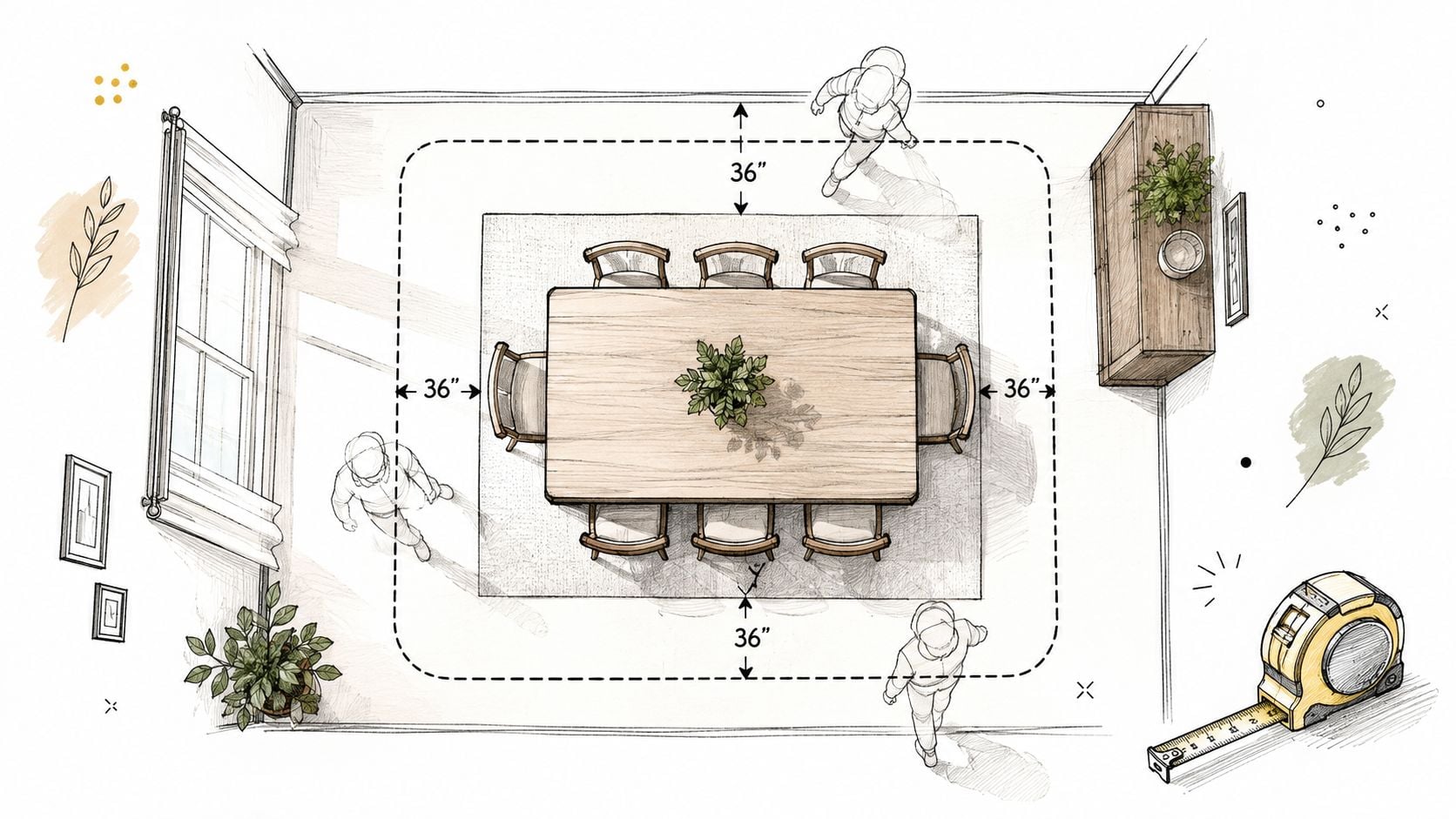
Start with the room, not the table. A dining set that blocks traffic, clips a doorway, or forces chairs too close to the wall will feel wrong no matter how good the wood looks. Good planning leaves at least 36 inches of open space on all sides so people can pull chairs out and move through the room without squeezing past corners. For a simple reference on table clearance and room flow, use this layout guide and check the Dining Table Size Guide before you buy.
Measuring the room the right way
Measure the full room first, then subtract the space needed for walkways, chair pull-out room, and any doors that swing into the dining area. A table can look perfect on paper and still fail once it sits beside a hallway, a buffet, or the path into the kitchen. That problem shows up fast in open-concept homes, where the dining area shares space with daily foot traffic.
Pay attention to the footprint, not just the seat count. A representative 6-piece solid-wood dining set is listed at 72 in × 36.75 in × 30 in and seats up to 6 people, with a table weight of 113 lb and an apron clearance of 26.35 in (product dimensions). Another 6-to-8-seat extendable set is listed at 88.5 in long, 33.5 in wide, with bench seating, a drop leaf, and a 300 lb chair weight capacity (product dimensions). Those listings show why shoppers need to check length, width, apron clearance, and load expectations, not just how many people a set says it seats.
For Logan County families who rearrange rooms often, weight matters too. A heavier solid wood set is harder to move, but it usually stays planted better in daily use. If the dining room stays put, that tradeoff makes sense. If the space has to shift for cleaning, holiday gatherings, or a tighter floor plan, a very heavy set can become a burden.
Bellefontaine buyers should also test the layout with real furniture habits in mind. Leave room for chair backs, serving traffic, and the way people enter from the kitchen or living room. The goal is a room that works on a weekday night, not just one that looks balanced in a showroom.
Understanding Price Ranges and What You Get at Each Level
A solid wood dining set should cost more than a mass-market flat-pack table, and the reason should be visible in the build. In the U.S. market, a quality solid wood dining table seating four to six typically costs about $700 to $2,500, with entry-level solid hardwood tables around **$600 to $800 and mid-range hardwood tables such as oak or walnut often running $1,200 to $3,000 depending on species, size, and finish. For families in Bellefontaine, that price spread usually reflects the difference between a table that only looks solid and one that is built to stay in the room for years.
What moves the number up or down
Material choice changes the starting point fast. Tight-grain hardwoods, thicker tops, better joinery, and a cleaner finish all raise the price because they take more labor and better stock. Custom sizing, matching chairs, and details like hand-applied finishes or more careful edge work also push the total up. The number is not just about wood, it is about how much skill went into turning that wood into a table or full set.
Shoppers should also verify what they are paying for before they compare tags. A table with a solid wood top and mixed-construction base is not the same thing as a fully solid set, and veneer over engineered core materials can look convincing on the floor. Run your hand under the edge, open drawers if the set has them, and ask directly what is solid wood, what is veneer, and what is substrate. That habit saves Logan County buyers from paying hardwood money for partial construction.
A well-made solid wood set earns its keep because it stays in service instead of getting replaced on a short cycle. Broader pricing coverage notes that wooden dining room furniture can reach much higher levels at the upper end of the market, which is another reminder that the long-term cost depends on how long the set holds up, not just the sticker price (price coverage). If the frame is tight, the joints are sound, and the finish can be maintained, the lower upfront option is not always the cheaper one.
Budget rule: buy the strongest construction you can afford, then choose the simplest finish or layout that still fits the room.
Bellefontaine and Logan County families should ask about the Low Price Promise and flexible financing before they rule a set out on price alone. That is a practical way to keep quality in reach without settling for disposable furniture. Tanger's Furniture also offers custom order options through brands like Smith Brothers of Berne and Flexsteel, which gives shoppers a way to tailor the size, wood, and finish without getting pushed into unnecessary retail markup.
Finish Options and Long-Term Care for Solid Wood
The finish is more than color. It affects shine, maintenance, scratch resistance, and how often the table needs attention after years of use. Lacquer, polyurethane, oil, and wax each change the experience of owning the piece, so buyers should look past the sample sheen and ask how the surface will live in a real dining room.
How to keep the surface in good shape
The simplest protection habits are the most effective. Use placemats or trivets for hot dishes, wipe spills quickly, and keep standing water off the surface. Sun exposure can also age a finish unevenly, so a table placed near bright windows benefits from occasional rotation and smart window coverings.
Ohio weather adds another layer of care because indoor humidity swings can affect the wood itself. A solid wood dining set will always respond to the environment to some degree, which is why gentle seasonal attention matters more than aggressive cleaning. Minor scratches often stay minor if they're handled early.
For ongoing care tips and finish-specific guidance, the How to Care for Wood Furniture guide is a useful reference. It fits well with a practical maintenance routine, especially for households that want their table to age gracefully instead of looking worn out.
When deeper damage shows up, refinishing can bring the piece back. That's one of the strongest reasons to choose solid wood in the first place, the furniture can often be renewed instead of replaced. Tanger's in-house service team and online Service Request portal are part of that long-term support, which helps after delivery when a repair question or maintenance issue comes up.
Your Solid Wood Dining Set Buying Checklist
A solid wood dining set deserves a careful final check before anyone signs off on it. At the showroom, look past the polished sample and verify the construction part by part, because the top, legs, aprons, and chairs do not always share the same build. Ask straight questions, inspect the joinery, and make sure the piece matches how your household uses a dining room in Bellefontaine or anywhere else in Logan County.
The first pass should happen with a clear eye and a tape measure. If the room has to handle family meals, homework, holidays, and occasional overflow from the living room, the set needs to fit those realities without crowding movement.
Use this checklist in the showroom
- Verify the build. Ask whether the top, legs, aprons, and chairs are solid wood or mixed construction.
- Check the species. Choose a harder wood for heavier use and a warmer, richer tone if the room is more formal.
- Inspect the joints. Tight seams and stable legs matter more than a glossy finish.
- Measure the room. Keep the 36-inch clearance rule in mind and check the full extended footprint.
- Match the budget. Balance the upfront cost against how long the set should realistically last.
- Choose the finish. Pick the surface that fits maintenance habits, not just the sample board.
Run the practical tests before you commit. Lift a chair, feel for wobble, pull a drawer if the set includes one, and check whether the leaves line up cleanly with the main top. If the piece has to move during a remodel or get stored between homes, review stress-free move storage tips so the finish and joints stay protected during the transition.
Use a smarter buying process, not a prettier showroom display. The How to Shop for Furniture Smartly guide gives shoppers a clear framework for comparing construction, value, and long-term fit without getting distracted by the wrong details.
Tanger's Furniture also handles local delivery and in-house service requests, so the heavy lifting gets managed both physically and after the sale. That matters for busy families, and it matters for business owners who want durable office or conference furniture in Logan County. The same straightforward approach also helps customers who are comparing dining pieces to other home needs like Speed Queen laundry or a mattress store Logan County search, because the right store should help with the whole home, not just one room.
Visit our showroom in Bellefontaine to see our custom options in person or browse our collections online to start your journey. Have a specific design question? Contact our design staff today or join our Love Your Home Club for expert tips delivered to your inbox.